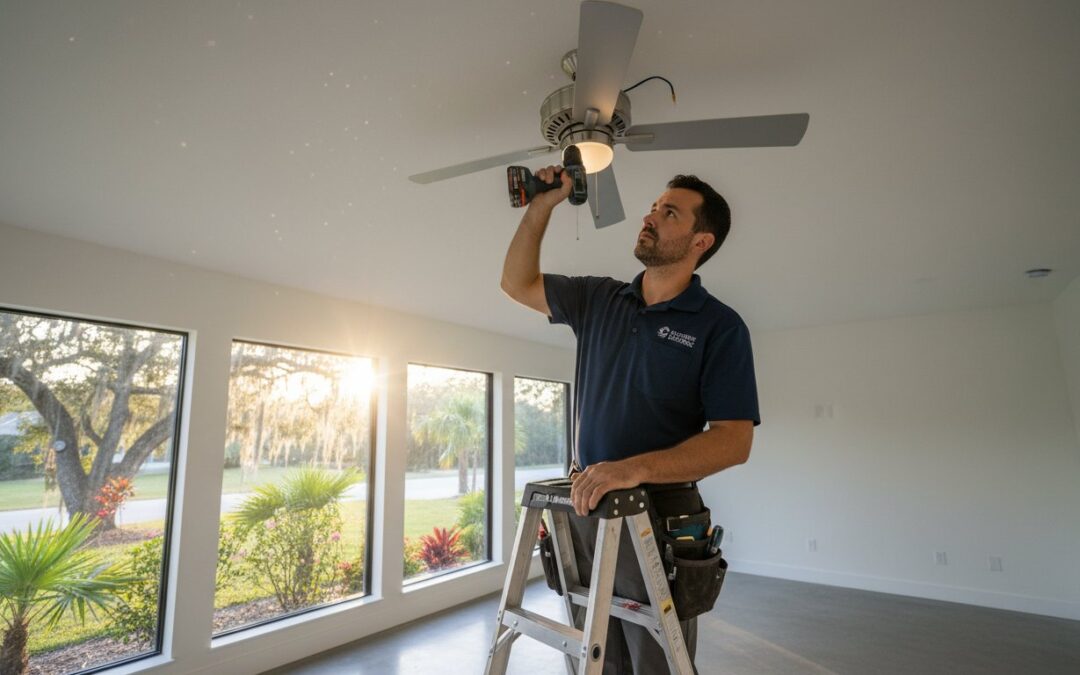
Professional Ceiling Fan Installation in Orlando: Safety, Style, and 1925 Legacy
Mar 8, 2026
Last July, a homeowner in Winter Park discovered that a simple DIY project led to a midnight ceiling failure because the junction box wasn’t rated for a 35-pound fixture. You know that the Florida heat is relentless, and you depend on your fans to keep cooling costs down without the constant distraction of a noisy, wobbling motor. It’s frustrating when a new purchase doesn’t perform as expected or, worse, creates a safety hazard for your family.
Professional ceiling fan installation in Orlando is the only way to guarantee a silent, efficient, and code-compliant breeze in every room. Since 1925, Sanford Electric, LLC has provided the technical expertise needed to secure heavy fixtures and prevent the electrical hazards that often lead to residential fires. We’ll show you how proper balancing can lower your monthly utility bills by 10% and why our family-owned team remains the trusted choice for Central Florida homes. This guide covers the safety benefits of expert mounting, the importance of structural integrity, and how we ensure your home stays cool and secure.
Key Takeaways
Discover how strategic fan placement manages Orlando’s “RealFeel” temperatures while significantly reducing your monthly HVAC energy consumption.
Understand the vital safety difference between standard light fixtures and fan-rated junction boxes to ensure your home remains secure.
Learn how to select the perfect fan size and motor technology to optimize airflow and durability for the unique Central Florida climate.
Explore why professional ceiling fan installation orlando is the most reliable way to handle heavy dynamic loads and complex electrical wiring.
Benefit from a century of expertise with a professional installation process rooted in the quality and tradition Sanford Electric has maintained since 1925.
Why Ceiling Fan Installation is Essential for Orlando Homes
Sanford Electric Co. II, Inc. has operated as a family-owned business in Central Florida since 1925. Throughout nearly a century of service, we’ve observed how local weather patterns dictate the requirements for indoor comfort. In Orlando, it’s rarely just about the temperature on the dial. High humidity levels create a “RealFeel” that often makes a 90-degree afternoon feel like 102 degrees. Reliable airflow is the most effective tool for managing this environmental stress without overworking your electrical system.
Fans operate on the principle of the wind chill effect. They don’t technically lower the temperature of a room; instead, they circulate air across the skin to facilitate moisture evaporation. This physical process makes occupants feel six to eight degrees cooler than the ambient air temperature. Reviewing the history of the ceiling fan shows that these mechanical solutions were essential long before residential air conditioning became a standard feature in Orange County. Our team ensures that every ceiling fan installation orlando project we handle accounts for proper blade pitch and motor power to maximize this cooling effect.
Combating Central Florida Humidity
Stagnant air creates a breeding ground for indoor air quality issues. In many older Sanford homes, humidity settles in stagnant pockets, which can lead to localized moisture problems or a persistent damp sensation. Constant air movement breaks up these pockets and helps maintain a more uniform environment. Homeowners with “Great Rooms” or vaulted ceilings benefit the most from professional placement. Without a high-performance fan, heat rises and stays trapped 12 feet above your head. A properly installed unit pushes that air down to the living zone where it’s actually needed.
Energy Efficiency and Cost Savings
Financial savings are a primary driver for our clients. Data from the Department of Energy suggests that using a ceiling fan allows you to raise the thermostat by 4 degrees with no reduction in comfort. For an Orlando resident, this adjustment can lead to a 4% to 8% decrease in monthly cooling expenses. We recommend pairing modern fans with smart thermostats to automate these gains. When the house is empty, the fans should stay off. When you return, the fan provides immediate relief while the HVAC system works at a more efficient, steady pace.
Our technicians also emphasize the importance of the seasonal rotation trick. Most fans feature a small switch on the motor housing. In the summer, blades should spin counter-clockwise to create a direct downdraft. During the brief Florida winter, reversing the direction to clockwise at a low speed pulls cool air up and pushes trapped warm air down. This simple adjustment helps manage heating costs during the few weeks when the temperature drops below 50 degrees. Since 1925, we’ve prioritized these practical, effective solutions for our neighbors. Choosing ceiling fan installation orlando services from a licensed professional ensures your home remains a sanctuary of comfort and efficiency year-round.
The Electrical Backbone: Safety Standards and Junction Boxes
Proper ceiling fan installation Orlando requires more than just connecting colored wires; it starts with the structural foundation of your ceiling. Most homeowners don’t realize that a standard electrical box designed for a light fixture is only rated for static weight. A ceiling fan is a dynamic load. As the blades spin, they create centrifugal force and vibration. This wobble-fatigue can cause a standard 1.5-inch deep plastic box to crack or pull through the drywall over time. National Electrical Code (NEC) Article 314.27(C) mandates that all boxes supporting fans must be specifically listed for that purpose. At Sanford Electric Co. II, Inc., we’ve seen the results of shortcuts since we opened in 1925. Our technicians perform a 10-point safety check to ensure your ceiling’s backbone can handle the 50 to 70 pounds of force generated by modern units.
The difference between a light box and a fan-rated box is life and death for your flooring and furniture. A light box uses #6-32 screws, which are thin and prone to shearing under movement. A fan-rated box uses heavy-duty #10-24 screws. These are designed to withstand the constant oscillation of a motor. If your home was built before the 1990s, there is a 65% chance your existing boxes aren’t rated for fans. We verify the weight capacity of every mounting point before the motor ever leaves the box. This level of precision is why our family-owned business has remained a Central Florida staple for nearly a century.
Identifying Fan-Rated Support Systems
You can identify a safe mounting system by looking for the “Acceptable for Fan Support” stamp inside the metal or heavy-duty plastic housing. If you see a thin plastic box held by two small screws, it’s a safety hazard. We often find that 40% of DIY installs in Central Florida use improper bracing. When a solid joist isn’t directly above the fan, we install a heavy-duty steel expansion brace. This ensures the fan stays anchored even at high speeds. These units must also meet modern federal energy efficiency standards to minimize power draw while maximizing airflow.
Wiring Complexity in Historic Orlando Homes
Orlando’s historic districts, like Lake Eola Heights or Delaney Park, often feature wiring challenges that modern kits don’t address. Homes built between 1965 and 1973 frequently contain aluminum wiring. This requires specific AlumiConn or CO/ALR connectors during a ceiling fan installation Orlando to prevent fire hazards caused by metal expansion. We also address the lack of dedicated grounding in pre-1950s homes. Proper grounding is vital in Central Florida, which averages 80 thunderstorm days per year. Without it, a lightning surge can fry your fan’s motor or remote receiver instantly. If you’re concerned about the age of your home’s wiring, our team can provide a professional wiring assessment to ensure your new fan operates safely for decades. We take the time to integrate separate switches for fan speed and light dimming, avoiding the clunky pull-chains that often break in high-use environments.
Our commitment to safety isn’t just a policy; it’s a legacy. Since 1925, we’ve approached every junction box and wire nut with the same disciplined care. We don’t just hang fans. We build reliable electrical systems that protect your family and your home investment.
Choosing the Right Fan for Your Central Florida Lifestyle
Selecting a fan involves more than picking a style you like at a big-box store. A fan that is too small won’t move enough air to combat 90 percent humidity, while one that is too large can create an uncomfortable wind tunnel effect. For a standard 12-by-12-foot bedroom, a 48-inch to 52-inch blade span is the professional standard. If you’re cooling an expansive 400-square-foot lanai, you’ll need a 60-inch or 72-inch model to maintain consistent airflow. Sanford Electric Co. II, Inc. has guided homeowners through these technical choices since 1925, ensuring every ceiling fan installation orlando project delivers maximum comfort and safety.
You must also choose between Alternating Current (AC) and Direct Current (DC) motors. While AC fans are common in older homes, DC motors are the superior choice for Florida’s year-round demands. These motors use up to 70 percent less electricity than standard AC models. A DC motor also offers more speed settings, often providing six or more levels of control. Because they run cooler, these motors typically last 5 to 10 years longer in our tropical climate. Our technicians have seen how the heat degrades lower-quality motors, which is why we recommend investing in high-efficiency DC options for long-term reliability.
The aesthetic evolution of fans has moved beyond the basic white plastic blades of the past. Modern interiors often benefit from sleek, three-blade designs in matte black or brushed nickel. Traditional homes in neighborhoods like Winter Park may still favor five-blade carved wood finishes. Regardless of the look, the internal components must be robust. A professional ceiling fan installation orlando ensures the mounting bracket is secured to a fan-rated junction box, which is designed to support the dynamic weight of a spinning motor that can weigh up to 50 pounds.
Indoor vs. Outdoor Ratings (Damp vs. Wet)
A standard indoor fan installed on an Alafaya patio will likely fail within 6 months. Humidity causes standard blades to sag and internal components to rust. UL Damp-rated fans handle moisture but cannot face direct rain. For exposed pergolas or gazebos, you must use a UL Wet-rated fan. These units feature sealed motors and all-weather blades that withstand direct spray from a heavy summer downpour without short-circuiting.
Smart Fan Integration and Automation
Modern fans do more than spin. You can now connect your cooling system to Alexa, Google Home, or Lutron setups. This allows for automated speed adjustments when the room temperature hits 78 degrees. Our team provides specialized Smart Home Device Setup to ensure your new fan communicates perfectly with your existing hub. This technology reduces energy waste by turning fans off when sensors detect an empty room, a feature that can save a household 15 percent on monthly cooling costs.
Since our founding in 1925, we’ve seen a century of design changes, but the requirement for a safe, balanced installation remains constant. We provide the technical expertise to ensure your fan is quiet, stable, and integrated correctly into your home’s electrical grid. This disciplined approach to service is why Central Florida families have trusted us for four generations.
The Sanford Electric Professional Installation Process
Sanford Electric Co. II, Inc. has refined its electrical protocols over nearly a century of service in Central Florida. When you schedule a ceiling fan installation orlando project with our team, the process begins with a rigorous load-bearing assessment. Many homes built before 1990 utilize electrical boxes rated only for light fixtures; these cannot support the 35 to 70 pounds of dynamic weight a modern fan generates. We verify that your junction box is securely anchored to a structural joist according to National Electrical Code (NEC) 314.27(C) standards. If the existing hardware is insufficient, we replace it with a heavy-duty, UL-listed fan brace that ensures your family’s safety. Our technicians also handle the safe removal of your old fixture and ensure it is disposed of or recycled according to local environmental regulations.
Precision balancing is a hallmark of our professional service. A fan that wobbles by even 1/8th of an inch can cause premature motor wear and irritating noise. We use specialized weights and digital measurements to ensure the unit remains silent at every RPM. Once the physical install is complete, we provide a hands-on tutorial. We’ll show you how to operate remote controls, integrate the unit with smart home hubs, and adjust the seasonal airflow switch to maximize energy efficiency. This personalized walkthrough ensures you’re comfortable with every feature of your new investment before we leave your home.
Step-by-Step Execution
Safety is our primary concern. We perform a full power lockout and verify the circuit with a digital multimeter before any wires are touched. Our technicians assemble the motor housing and internal wiring according to the specific 2024 manufacturer requirements. We mount the canopy flush to the ceiling and adjust the blade pitch, typically between 12 and 15 degrees, to move the maximum volume of air throughout your room. This methodical approach prevents the common mistakes found in DIY attempts, such as loose connections or reversed polarity.
Post-Installation Quality Check
Every ceiling fan installation orlando concludes with a multi-point inspection. We test all speed settings and light dimming ranges to ensure the capacitors are functioning correctly. We listen for resonance issues or the low-frequency humming that often plagues amateur installs. We provide every homeowner with our 1925-standard ‘Quality Service’ guarantee; this reflects our commitment as a family-owned business to provide lasting results. Our team checks the following during the final audit:
Verification of the 50-pound pull test for mounting stability
Check for 100% silent operation at high-speed settings
Confirming the remote sensor range and wall switch synchronization
Cleaning the work area to leave your home exactly as we found it
Our technicians have seen and solved every possible electrical issue over the last century. We don’t just hang a fan; we ensure it becomes a permanent, safe, and efficient part of your home’s infrastructure. If you’re ready to upgrade your comfort with a professional touch, we’re here to help.
Trust the Experts: Why Sanford Electric Co. II, Inc.?
Reliability isn’t a quality that develops overnight. It’s earned through decades of consistent performance and a commitment to safety. Sanford Electric Co. II, Inc. has served as a pillar of the Central Florida community since 1925. For 99 years, we’ve provided the technical precision required to handle the unique electrical demands of our region. When you choose us for your ceiling fan installation orlando project, you’re hiring a team that views electrical work as a serious craft, not just a list of tasks. We understand that a fan isn’t just a fixture; it’s a component of your home’s safety and comfort systems.
Our family-owned structure provides a level of personal accountability you won’t find with national franchises. We treat every home with the same care we’d give our own. This philosophy is backed by a team of technicians who are fully licensed, insured, and have passed comprehensive background checks. We don’t send strangers into your living space; we send professionals who represent four generations of reputation. Our expertise also extends far beyond simple installations. We provide comprehensive electrical solutions, from panel upgrades to complex commercial wiring, ensuring that your home’s infrastructure can support your modern cooling needs without risk of failure or fire.
A Century of Service in Orlando
Our history is deeply intertwined with the growth of Central Florida. Since 1925, we’ve adapted our methods to match the evolution of electrical standards. This century of experience benefits your modern home because we understand the architectural history of the area. Whether you live in a historic residence with legacy wiring or a new build in a developing suburb, we’ve seen and solved the specific challenges your property presents. Our commitment to the Sanford and Orlando communities is reflected in our 4.8-star service rating and our long-standing relationships with local families. “Quality Service Since 1925” isn’t a marketing phrase. It’s a promise that every connection we make is built to last for years to come.
Ready for a Cooler Home?
Upgrading your indoor climate shouldn’t be a complicated process. We’ve streamlined our scheduling to accommodate both residential homeowners and commercial property managers. You won’t have to deal with the typical “contractor surprises” that disrupt your budget. We provide transparent pricing based on the specific requirements of your project, ensuring you know the costs before the work begins. Our technicians arrive on time, equipped with the tools necessary to complete your ceiling fan installation orlando safely and efficiently. We take pride in our disciplined approach, maintaining a clean workspace and verifying every safety protocol before we consider the job finished. Don’t settle for unproven labor when you can rely on a local institution. Schedule your professional ceiling fan installation today and secure the peace of mind that comes from century-old expertise.
Secure Your Comfort with a Century of Expertise
Enhancing your Central Florida home requires more than just a new fixture; it demands a foundation of safety and technical precision. Professional ceiling fan installation orlando ensures that every junction box meets modern safety standards and every motor is balanced for maximum efficiency. Since 1925, Sanford Electric Co. II, Inc. has provided the steady hand needed to navigate complex wiring and structural requirements. Our family owned and operated team brings the expertise of licensed and insured Master Electricians to every project, protecting your investment and your peace of mind.
Don’t settle for unstable mounts or flickering lights when you can rely on a legacy of excellence. We’ve spent nearly 100 years perfecting our process to keep local families cool and safe. Whether you’re upgrading a single room or outfitting an entire property, our technicians deliver the dependable results your home deserves. Keep your home cool with professional installation from Sanford Electric and enjoy the reliable breeze of a job done right. We look forward to serving your family soon.
Frequently Asked Questions
How much does professional ceiling fan installation orlando cost?
Professional ceiling fan installation orlando typically costs between $150 and $350 per unit for standard ceiling heights. This price depends on the complexity of your home’s wiring and the ceiling’s pitch. Since 1925, we’ve provided transparent pricing for Central Florida homeowners. Adding a new brace or running a 14/2 electrical line may increase the final investment by $100 or more to ensure a safe, permanent setup.
Can I replace a light fixture with a ceiling fan myself?
You can replace a light fixture with a fan only if the existing junction box is UL-listed for fan support. Standard light boxes are designed for 35 pounds or less; however, fans require a heavy-duty box rated for 70 pounds to handle the dynamic weight of the motor. If you’re unsure, our licensed technicians can verify your hardware. This small step prevents the fixture from falling and ensures your family stays safe.
How long does it take for an electrician to install a ceiling fan?
A professional electrician generally completes a standard installation in 60 to 90 minutes. If your project requires a new circuit or a 10-foot downrod, the process might take up to 3 hours. We focus on precision and safety during every minute spent on your property. Our team arrives with the specialized tools needed to secure your fixture correctly the first time, ensuring long-term reliability for your Central Florida home.
Why is my ceiling fan wobbling or making a humming noise?
A wobbling fan often results from a blade misalignment of 1/8 inch or more. Humming noises are frequently caused by loose screws in the motor housing or the use of an incompatible dimmer switch. We recommend checking the blade tracking with a yardstick first. If the noise persists, it may indicate a capacitor failure or an imbalanced motor that requires professional calibration to prevent further damage to the unit.
Do I need a special permit for ceiling fan installation in Orange County?
You don’t need a permit for a simple fixture replacement in Orange County. However, the Florida Building Code requires a permit if you’re installing 5 or more feet of new wiring or adding a dedicated circuit. Sanford Electric Co. II, Inc. has navigated local building codes since our founding in 1925. We ensure every job meets the current National Electrical Code standards to maintain the safety of your residence.
What size ceiling fan do I need for a 12×12 room?
A 12×12 room requires a fan with a blade span of 48 to 54 inches for optimal airflow. This size provides enough coverage for the 144 square feet of space without overwhelming the room’s proportions. Choosing a fan that is too small forces the motor to run at higher speeds, which increases wear and energy consumption over its 10-year lifespan. Proper sizing ensures the motor operates efficiently and quietly.
Can you install a ceiling fan if there is no existing wiring?
We can install a fan in any room by running new electrical lines through your attic or walls. This process involves installing a fan-rated box and a new wall switch to control the unit effectively. Our experienced team handles this task with minimal disruption to your drywall. It’s a dependable way to improve comfort in older Central Florida homes built before the year 1970 that lack modern overhead fixtures.
Should my ceiling fan rotate clockwise or counter-clockwise in the summer?
Your fan should rotate counter-clockwise in the summer to create a direct downdraft. This “wind chill” effect can make a room feel 6 to 8 degrees cooler, allowing you to raise your thermostat and save on cooling costs. In the winter, you should reverse the motor to a clockwise direction at low speed. This pulls cool air up and pushes trapped warm air down from the ceiling to improve heat distribution.
Categories
Archives
Manage Consent
To provide the best experiences, we use technologies like cookies to store and/or access device information. Consenting to these technologies will allow us to process data such as browsing behavior or unique IDs on this site. Not consenting or withdrawing consent, may adversely affect certain features and functions.
Functional
Always active
The technical storage or access is strictly necessary for the legitimate purpose of enabling the use of a specific service explicitly requested by the subscriber or user, or for the sole purpose of carrying out the transmission of a communication over an electronic communications network.
Preferences
The technical storage or access is necessary for the legitimate purpose of storing preferences that are not requested by the subscriber or user.
Statistics
The technical storage or access that is used exclusively for statistical purposes.The technical storage or access that is used exclusively for anonymous statistical purposes. Without a subpoena, voluntary compliance on the part of your Internet Service Provider, or additional records from a third party, information stored or retrieved for this purpose alone cannot usually be used to identify you.
Marketing
The technical storage or access is required to create user profiles to send advertising, or to track the user on a website or across several websites for similar marketing purposes.