
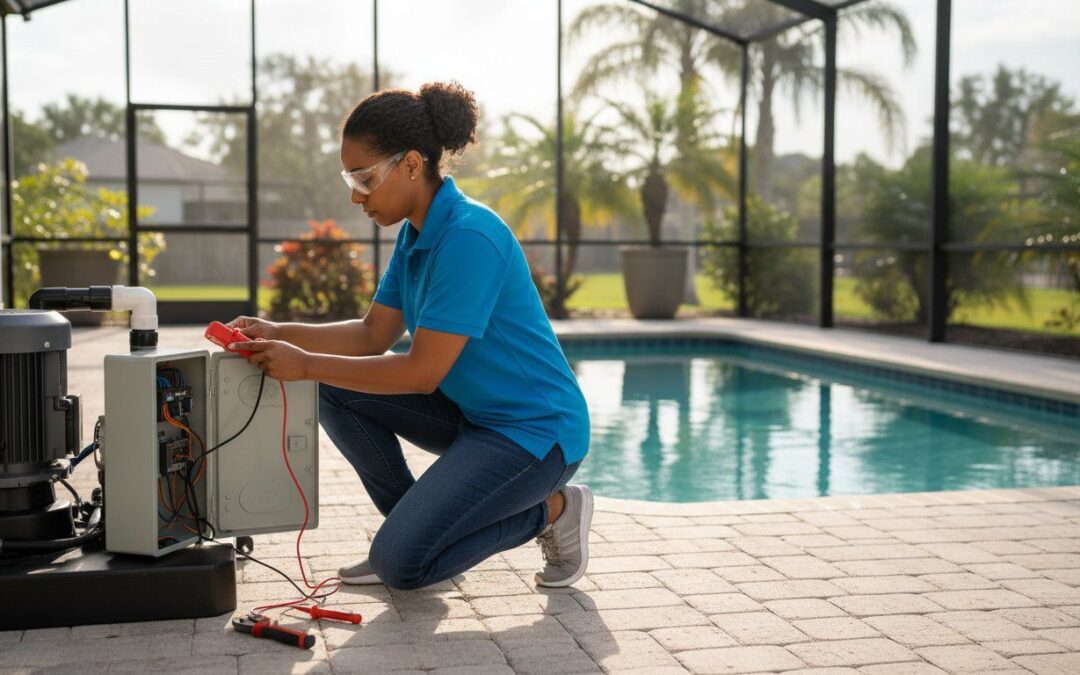
Could the very water meant for your family’s relaxation actually be a conductor for a silent, invisible threat? In Central Florida, where high humidity and frequent lightning strikes accelerate wiring corrosion, maintaining your backyard oasis requires more than just clear water. A professional pool wiring safety inspection Orlando homeowners can trust is the only way to ensure your bonding grid is intact and your family is safe from electric shock drowning. At Sanford Electric, LLC, we’ve provided this essential peace of mind to our neighbors since 1925.
We understand that technical terms like equipotential bonding and GFCI requirements can feel overwhelming. You likely want to know if your older pool still meets modern safety standards without being pressured into unnecessary work. This guide explains exactly what happens during a professional electrical audit, from testing the 2026 NEC perimeter bonding zones to verifying your pump’s ground fault protection. You’ll learn how the latest 2026 Florida Building Code updates affect your property and how to identify the early warning signs of electrical failure before they become a crisis.
Key Takeaways
- Orlando’s unique climate of high humidity and frequent lightning creates a high-corrosion environment that requires regular professional oversight.
- A comprehensive pool wiring safety inspection Orlando homeowners schedule will verify that bonding grids and GFCI protections comply with the latest 2026 NEC standards.
- Distinguishing between grounding and bonding is essential for maintaining the “invisible safety net” that prevents electric shock drowning.
- Identifying common warning signs, such as flickering pool lights or breakers that trip after a storm, can help you address hazards before they become dangerous.
- Relying on a family-owned institution with nearly a century of local experience ensures your pool’s electrical system is handled with professional care and technical precision.
What is a Pool Wiring Safety Inspection in Orlando?
A professional pool wiring safety inspection Orlando homeowners schedule is a specialized technical audit of every electrical component that serves an aquatic environment. Unlike a standard home inspection that focuses on the overall structure of a property, this audit is a deep dive into the hidden systems that keep your water safe. It involves a master electrician testing the integrity of the bonding grid, the functionality of ground fault circuit interrupters (GFCIs), and the condition of underwater lighting fixtures. Since 1925, we have seen how even a minor oversight in these systems can lead to significant safety risks.
There is a major difference between a visual check performed by a general inspector and a technical audit conducted by a qualified electrician. A general inspector might confirm that a light turns on; a professional electrical audit measures the actual resistance in the grounding system to ensure it can handle a fault. We use calibrated equipment to verify that your pool equipment pad, pump motors, and heaters are correctly integrated into the safety system. This level of precision is necessary because electricity and water are a lethal combination when managed incorrectly.
Why Central Florida Pools Face Unique Electrical Risks
Orlando is often called the lightning capital of the United States. Frequent afternoon storms don’t just threaten your roof; they send massive surges through the ground that can degrade the insulation on your pool’s underground wiring. Our high humidity levels also accelerate the oxidation of copper conductors. When copper oxidizes, it creates resistance, which generates heat and reduces the effectiveness of your safety equipment. Additionally, the high water table in Central Florida can lead to water intrusion in underground conduits, causing wires to sit in stagnant moisture for years. These local factors make annual inspections a necessity rather than an option.
NEC Article 680: The Gold Standard for Aquatic Safety
The National Electrical Code (NEC) Article 680 is the regulatory backbone for all swimming pool installations. It provides the specific requirements for equipotential bonding, which is the process of connecting all metallic components around a pool to ensure they stay at the same electrical potential. This prevents a person from becoming the path for electricity between two different surfaces. These codes have evolved significantly over the decades to address the threat of Electric Shock Drowning (ESD). Many Orlando pools built before the early 2000s don’t meet these modern benchmarks. Our technicians ensure your system aligns with the latest 2026 standards, providing the stability and peace of mind your family deserves.
The 5-Step Professional Pool Electrical Inspection Process
A professional pool wiring safety inspection Orlando homeowners rely on follows a rigorous, methodical sequence. We don’t just glance at your equipment; we perform a technical audit designed to uncover hidden hazards. Since 1925, our family has focused on the fine details that ensure electrical stability in the high-moisture environments of Central Florida. Our process moves from a visual assessment to high-precision technical testing, concluding with a clear path to safety.
Step 1: Inspecting the Equipment Pad and Pumps
Our technicians start at the heart of your system. We check for proper motor grounding and verify that all conduit connections are weather-rated and secure. In many older Central Florida homes, we often find dangerous DIY wiring shortcuts where standard indoor components were used instead of necessary NEMA-rated enclosures. We ensure your timers and automation systems are housed correctly to withstand our intense tropical storms and high humidity levels.
Step 2: Underwater Lighting and Niche Security
Underwater lights are the most common source of stray voltage in a pool. We test for voltage leaks in aging light niches and verify that wet-niche luminaires are properly sealed and bonded. This step is critical, as official government safety warnings highlight the severe risks of faulty underwater lighting. We also evaluate the transition from high-voltage halogen systems to modern, low-voltage LED safety standards to reduce the risk of shock.
Step 3: GFCI Protection and Panel Integrity
Every pool circuit requires a dedicated, functional Ground Fault Circuit Interrupter (GFCI) breaker. We perform trip-time and sensitivity testing to ensure these devices react instantly to a fault. During this phase, we inspect the main electrical panel and pool-specific sub-panels for signs of heat damage, corrosion, or “double-tapping.” If your system is outdated, a professional electrical panel upgrade may be necessary to support modern safety equipment and high-efficiency pumps.
Steps four and five involve technical continuity testing of the bonding grid and the delivery of a final safety report. We measure the electrical potential between metallic components and the water itself to confirm your “invisible safety net” is intact. Finally, we provide a prioritized list of recommendations. If you haven’t had your system checked recently, our team at Sanford Electric, LLC is ready to help you maintain a safe environment for your family.
Grounding vs. Bonding: The Invisible Safety Net
Homeowners often use the terms grounding and bonding interchangeably, but they serve two distinct and vital roles in your backyard safety. Grounding is designed to protect your equipment. It provides a dedicated path for fault current to return to the electrical source, which trips the breaker if a motor fails. Bonding, however, is designed to protect people. It creates an “equipotential” environment where all metallic components are connected, ensuring they stay at the same electrical level. A comprehensive pool wiring safety inspection Orlando residents trust must prioritize this distinction to prevent serious accidents.
It’s entirely possible to have a perfectly grounded pump while still having a dangerous, unbonded pool ladder. If a fault occurs and your ladder isn’t part of the bonding grid, a swimmer touching the ladder while in the water could become the path for electricity. This happens because the water and the metal ladder are at different electrical potentials. By connecting every piece of metal, from the pump shell to the rebar in your pool deck, we eliminate that difference. Since 1925, our family has seen how a properly installed bonding grid acts as an invisible safety net, neutralizing voltage before it can reach a swimmer.
The Dangers of Stray Voltage in Unbonded Pools
Stray voltage is often subtle. You might feel a slight “tingle” when touching a metal rail or entering the water. This is a major warning sign that your bonding grid is compromised. Even a small voltage difference can cause a paralyzing shock in an aquatic environment. We use a #8 solid copper wire to link these components, but this wire can be severed during landscaping or corrode due to Central Florida’s acidic soil. Reviewing Pool and Spa Safety Tips from industry experts reinforces why maintaining this connection is a non-negotiable safety requirement.
Verifying the Equipotential Plane
Verification requires more than a visual check. Our technicians use low-resistance ohmmeters to test for continuity between every metallic point around your pool. This is the most technical and critical part of an Orlando pool safety inspection. We check several common points, including:
- Pool Ladders and Handrails: These must be connected to the grid even if they are removable.
- Diving Board Stands and Slides: Any metallic structural support requires bonding.
- Pump and Heater Shells: These must be bonded to the same grid as the pool deck.
- Underwater Light Niches: Ensuring the metal housing is at the same potential as the water.
If your pool was built several decades ago, these connections may have vibrated loose or succumbed to oxidation. We specialize in identifying these breaks in the “invisible net” to restore the stability and peace of mind your family deserves.
Warning Signs Your Orlando Pool Needs Immediate Inspection
Electrical hazards in a swimming pool don’t always announce themselves with a spark or a pop. Often, they hide behind equipment pads or deep within underwater niches until they reach a critical failure point. Recognizing the early warning signs is the first step in maintaining the stability of your home’s electrical system. If you notice any of these symptoms, a professional pool wiring safety inspection Orlando experts provide is the only way to confirm your family’s safety and restore your peace of mind.
One of the most urgent signals is a “tingling” sensation when you touch a metal handrail or enter the water. As discussed earlier regarding bonding grids, this indicates stray voltage is present. You should also watch for flickering pool lights when the pump motor starts. This suggests a voltage drop or a loose connection that could eventually lead to an electrical fire or equipment damage. Visible rust or green corrosion, known as verdigris, on electrical conduits or pump motors is another red flag. In our humid Central Florida climate, this oxidation can quickly eat through copper conductors and compromise your grounding system.
Post-Storm Electrical Hazards
Orlando’s frequent afternoon storms create unique challenges for outdoor electrical systems. If your circuit breakers trip frequently after a typical tropical downpour, it’s a clear sign of water intrusion in your outdoor conduits or junction boxes. Lightning strikes can also cause “silent” GFCI failure; the device may appear to work, but its internal components are fried and will no longer protect you from a ground fault. After any direct strike nearby, we recommend professional testing to ensure these safety devices still trip as designed.
The 10-Year Rule for Pool Wiring
We recommend a comprehensive audit for any pool wiring over 10 years old. Salt-chlorine generators, while popular, accelerate the corrosion of electrical connections through a process called electrolysis. These systems require even more diligent bonding to prevent metal components from degrading prematurely. A typical pool light gasket in Orlando’s heat and chemical environment generally lasts between two and three years before it loses its watertight seal. When these seals fail, water enters the niche and creates a direct path for electricity into your pool. If you see cracked or loose lenses, don’t wait for a failure to occur. Contact Sanford Electric, LLC to schedule your safety inspection today and ensure your oasis remains a safe retreat.
Trusting Sanford Electric’s Century of Experience for Your Safety
Sanford Electric Co. II, Inc. has anchored the Central Florida community with dependable electrical service since 1925. For four generations, our family-owned and operated business has prioritized technical proficiency and neighborly service above all else. We don’t just follow modern codes; we have witnessed the evolution of electrical standards in real-time over the last century. Our technicians bring a level of disciplined care to every pool wiring safety inspection Orlando homeowners request, ensuring that your aquatic environment remains a place of relaxation rather than a source of risk.
Our specialized expertise extends beyond simple residential setups to complex commercial aquatic systems. This depth of knowledge allows us to approach every project with a calm, confident delivery. We focus on transparent, code-compliant remediation that addresses the root cause of electrical instability. When you hire us, you are not just getting a service provider; you are partnering with a local institution that has seen and solved every possible electrical issue over the last hundred years.
Why a Licensed Electrician Trumps a General Inspector
A general home inspector provides a valuable overview of a property, but they often lack the specialized diagnostic tools required for aquatic environments. They might identify a visible defect, but they cannot measure the resistance of a bonding grid or test the trip-time of a GFCI breaker with technical precision. As licensed electrical contractors, we have the legal authority to perform immediate repairs rather than just noting problems. We frequently leverage our history to solve complex wiring puzzles in older Orlando neighborhoods, where legacy systems require a seasoned expert to meet modern safety benchmarks.
Schedule Your Comprehensive Safety Audit Today
Electrical safety is rarely a standalone issue. Your pool’s electrical health is directly tied to the integrity of your home’s main service panel and grounding system. We often suggest that clients bundle their pool audit with a general electrical safety inspection to ensure their entire property is protected from surges and faults. Our process is steady and efficient, concluding with a clear, written safety report that prioritizes necessary updates for your peace of mind.
Protect your family—book your pool wiring inspection with Sanford Electric Co. II and secure the professional care that Central Florida has trusted since 1925. We are ready to help you maintain a safe, stable, and enjoyable backyard oasis for years to come.
Securing Your Backyard Oasis for the Future
Maintaining a safe swimming environment in Central Florida requires constant vigilance against the corrosive effects of high humidity and frequent electrical storms. You now understand that a professional pool wiring safety inspection Orlando homeowners schedule is more than a simple checkup. It is a technical verification of the bonding grid and GFCI protections that keep your family safe. Our licensed and insured master electricians combine technical precision with a family-owned Central Florida legacy that dates back to 1925. We provide the stability and expertise needed to ensure your pool equipment meets the latest 2026 NEC standards and Florida building codes.
Don’t leave your aquatic safety to chance or wait for a minor warning sign to become a dangerous hazard. Trust the Quality Service Since 1925 that has anchored our community for a century. Schedule Your Orlando Pool Safety Inspection Today and enjoy the peace of mind that comes from true professional care. We look forward to serving your family and keeping your home safe for another generation of Florida summers.
Frequently Asked Questions
How often should I have my pool wiring inspected in Orlando?
You should schedule a professional audit every one to two years. Orlando’s unique climate, characterized by intense humidity and frequent lightning strikes, accelerates the degradation of copper conductors and conduit seals. Regular checkups ensure that your bonding grid and GFCI devices remain functional before the peak summer swim season begins. If you have an older pool or a salt-chlorine system, annual inspections are highly recommended to catch corrosion early.
Can a pool inspection prevent electric shock drowning (ESD)?
A comprehensive pool wiring safety inspection Orlando homeowners trust is the most effective way to prevent ESD. Our technicians identify invisible hazards like stray voltage or compromised bonding wires that a simple visual check will miss. By verifying that all metallic components and the water itself are at the same electrical potential, we neutralize the risk of paralyzing shocks that lead to drowning accidents.
Is a visual pool inspection by a home inspector enough for insurance?
Most insurance providers in Florida require a more detailed technical assessment than a standard home inspector can provide. A master electrician’s audit involves specialized testing of grounding resistance and bonding continuity using calibrated meters. This professional documentation proves your system meets current safety standards, which is often a requirement for policy coverage or renewals on properties with legacy electrical systems.
What happens if my pool wiring is not up to current NEC code?
If your wiring fails to meet the 2026 NEC standards, you face increased safety risks and potential liability issues. While some older systems may be considered “grandfathered,” they often lack the advanced GFCI protection and equipotential bonding required for modern safety. We provide prioritized remediation plans to bring your system into compliance with current codes, ensuring your backyard remains a stable and safe environment.
Why does my pool’s GFCI breaker keep tripping after it rains?
Frequent tripping after a typical Orlando afternoon storm usually indicates water intrusion in your outdoor junction boxes or underground conduits. Moisture creates a path to ground that the GFCI correctly identifies as a fault, causing it to shut off power. This is a clear warning sign that your weather-rated enclosures or seals have failed and need professional attention to prevent a permanent short or equipment damage.
Can I replace a pool light myself or do I need a licensed electrician?
You should always hire a licensed electrician to handle underwater lighting repairs or replacements. The process involves more than just changing a bulb; it requires verifying the watertight seal of the gasket and ensuring the niche remains properly bonded to the grid. Incorrect installation can lead to lethal voltage leaks into the pool water, making this a high-risk task that requires professional expertise.
What is stray voltage and how do I know if my pool has it?
Stray voltage is the presence of electrical current in the water or on metallic surfaces where it doesn’t belong. You may notice it as a “tingling” sensation when you touch a handrail or enter the pool. We use specialized low-resistance meters to detect these voltage leaks that are invisible to the naked eye but indicate a serious failure in your pool’s bonding system.
Does Sanford Electric provide pool wiring for new construction in Sanford?
Our team handles professional pool and hot tub wiring for both new construction and major renovations throughout Sanford and the surrounding Central Florida area. We ensure every new installation is built to exceed current safety codes from the very beginning. Our family-owned legacy since 1925 means we bring nearly a century of local expertise to every project, providing the quality and reliability your new home deserves.