
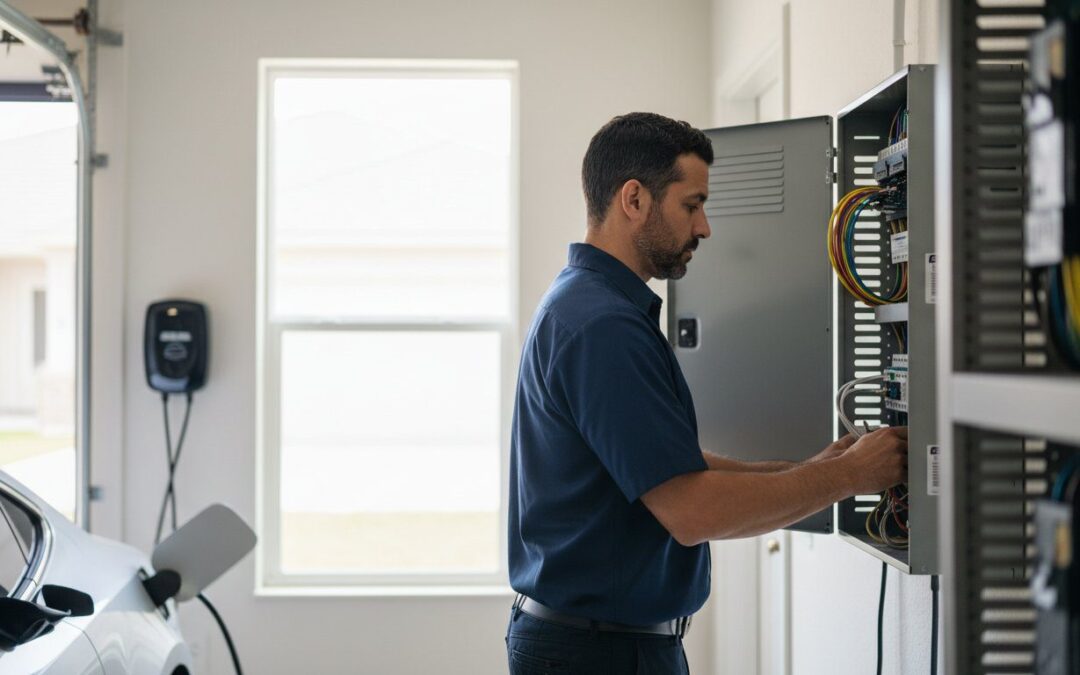
On a humid Tuesday afternoon in July 2025, a Sanford homeowner plugged in a new Level 2 EV charger only to hear a sharp pop from the garage. This wasn’t a simple fluke; it was a clear warning that their 200-amp panel had finally reached its limit. You likely believe your home’s wiring is a silent partner that can handle any new gadget you buy. However, without a precise load calculation electrical assessment, you’re essentially guessing with your family’s safety. Overloading circuits remains a leading cause of the 45,000 home electrical fires reported annually in the United States. Since 1925, our family-owned team at Sanford Electric Co. II, Inc. has provided the steady expertise needed to keep Central Florida homes running safely.
We know that navigating the 2026 National Electrical Code (NEC) requirements feels confusing and the thought of unexpected upgrade costs is stressful. This guide will help you master the essentials of your home’s power capacity so you can plan for smart home upgrades or solar integrations with absolute confidence. We’ll walk through how to evaluate your current demand, explain modern safety standards, and show you exactly when to call a licensed local electrician to protect your investment and your peace of mind.
Key Takeaways
- Understand how a precise load calculation electrical protects your Sanford or Orlando home by ensuring your system meets the safety standards of the National Electrical Code.
- Learn the professional NEC 220 method for determining power demand, accounting for everything from living space square footage to dedicated laundry circuits.
- Identify the unique Central Florida factors, such as year-round HVAC operation and pool equipment, that can unexpectedly strain your home’s electrical capacity.
- Recognize why professional verification is essential to satisfy local building inspectors and avoid the safety risks associated with basic DIY online calculators.
- Explore reliable solutions for managing modern power demands, including service panel upgrades and sub-panels that provide peace of mind for your next home improvement.
What is a Load Calculation Electrical and Why Does it Matter?
A load calculation electrical is the formal process of determining the total power demand a property places on its electrical system. It is not a rough estimate or a guess. It is a precise mathematical assessment based on the National Electrical Code (NEC) Article 220. This code sets the legal safety standards for how much electricity your home can draw without risking a catastrophic failure. By calculating the wattage of every fixed appliance, lighting circuit, and outlet, we determine the exact amperage your service panel must support.
For homeowners in Sanford and Orlando, this calculation is a critical safety barrier. Our Central Florida climate forces air conditioning units to run for 2,500 to 3,000 hours per year. This constant high demand creates thermal stress on your wiring. A proper calculation ensures your system handles these continuous loads without overheating. Without it, you risk two major issues:
- Fire Hazards: Overloaded wires generate heat that can melt insulation and ignite surrounding building materials.
- Equipment Failure: Voltage drops caused by an undersized system can burn out the sensitive motors in your $6,000 HVAC system or your pool pump.
The Evolution of Power Demands Since 1925
Sanford Electric Co. II, Inc. has tracked the changing energy needs of Central Florida across four generations of family leadership. When we began in 1925, a standard 60-amp service was the industry benchmark. It powered a few light bulbs and perhaps a single radio. Today, that is entirely insufficient. Modern 2026 standards typically require a 200-amp service to accommodate the “always-on” nature of our homes. Between high-speed networking gear, electric vehicle chargers, and smart appliances, the baseline load of a modern house is 400% higher than it was just a few decades ago. We use our century of experience to ensure your load calculation electrical accounts for both today’s needs and future technology upgrades.
Signs Your Current Load is Reaching Capacity
Your home’s electrical system often gives clear warnings before a total breakdown. If your kitchen lights flicker when the 5-ton AC compressor or the pool pump kicks in, your system is struggling with the initial surge of power. You should also check your service panel regularly. Circuit breakers that feel warm to the touch or emit a faint buzzing sound are immediate red flags that the hardware is operating at its thermal limit. Frequent tripping isn’t just a nuisance; it’s a vital safety signal. If you notice these symptoms, it’s time for a professional electrical safety inspection in Orlando to verify your system’s integrity and prevent permanent damage to your property.
How to Perform a Residential Load Calculation: The NEC 220 Method
Performing a precise load calculation electrical assessment requires following the National Electrical Code (NEC) Article 220. This standard ensures your Sanford home’s electrical panel can handle modern demands without overheating or tripping breakers. Since 1925, Sanford Electric Co. II, Inc. has used these precise calculations to maintain the safety of Central Florida residences.
First, calculate the total square footage of your living area. The NEC assigns 3 volt-amperes (VA) per square foot for general lighting and receptacles. For a 2,500 square foot home, this starts your base at 7,500 VA. Second, add the required constants for specific circuits. You must include 1,500 VA for each of the two required small appliance kitchen circuits and another 1,500 VA for the laundry circuit, totaling 4,500 VA for these areas.
Third, list your fixed appliances. This includes your water heater, garbage disposal, and dishwasher. Always use the specific ratings found on each unit’s nameplate for accuracy. Fourth, apply demand factors for your range and clothes dryer based on NEC tables. The code allows for these reductions because homeowners rarely use every burner and the dryer at maximum heat simultaneously. Finally, compare your total heating load against your cooling load. In our humid Orlando climate, the air conditioning load is typically the larger value. You only include the larger of the two in your final total to avoid overbuilding the service.
Understanding VA vs. Watts in Calculations
Electricians use Volt-Amps (VA) because it represents the apparent power the system must be capable of delivering, whereas Watts represents the actual power consumed. In a 2026 home, Watts equals the product of Volts and Amps multiplied by the power factor of the specific device. To convert nameplate data into usable figures, multiply the listed Amps by the circuit voltage, which is typically 120V or 240V. This prevents underestimating the actual strain on your home’s wiring infrastructure.
The 80% Rule for Continuous Loads
Safety standards dictate that a circuit shouldn’t exceed 80% of its rated capacity if the load runs for three hours or more. This rule is vital for space heaters, pool pumps, or electric vehicle chargers that draw heavy current for long durations. If a circuit is rated for 20 Amps, you should only plan for a 16-Amp continuous load. Professional oversight from our experienced team ensures your system maintains this safety buffer. If you’re concerned your current panel is reaching its limit, you can schedule a professional load assessment to verify your home’s safety. We’ve provided this level of dependable service to our community for nearly a century.
Central Florida Factors: High-Demand Loads in Sanford and Orlando
Living in Central Florida places unique stress on residential wiring systems. Our team has served this community since 1925, and we understand that local climate conditions dictate energy needs more than almost any other factor. In Orlando, air conditioning units often run for 10 months out of the year. This constant operation means your HVAC system is the single largest contributor to your home’s demand, often consuming 40% to 50% of your total monthly kilowatt-hours.
To mitigate this high energy demand, many homeowners invest in better thermal protection. You can discover Standard Insulation to learn how professional attic and wall insulation can reduce your HVAC’s runtime, which in turn lowers the continuous strain on your home’s electrical infrastructure.
Pool pumps and electric heaters represent a significant hidden load that many homeowners overlook. A standard single-speed pump can add roughly 1.5 to 2 kilowatts to your continuous load. When you combine this with whole-home dehumidifiers designed to combat our 74% average humidity, the strain on older 100-amp or 150-amp panels becomes immense. These systems operate for long cycles, meaning they must be calculated at 125% of their rated load per National Electrical Code requirements.
Expanding your outdoor living space also requires careful planning. Integrating landscape lighting in Sanford adds transformers and peripheral circuits that must be factored into your load calculation electrical study. Even low-voltage LED systems have a cumulative impact on your home’s total capacity, especially when paired with outdoor kitchens or patio heating elements.
The Surge of EV Charging in Central Florida
The transition to electric vehicles is a primary reason Sanford homeowners seek our expertise. A Level 2 charger requires a dedicated 40-amp to 60-amp circuit, which is roughly equivalent to adding a second large air conditioning unit to your home. Every EV charger installation in Orlando must begin with a load study to ensure your service entrance can handle the surge. If the math shows your panel is near its limit, we often implement smart energy management or load-shedding devices. These controllers temporarily pause the car charger when high-demand appliances like the clothes dryer are active, preventing the need for a costly full panel upgrade.
Backup Power: Generators and Load Calculations
Florida’s hurricane season makes backup power a critical investment for local security. A professional load calculation electrical determines the exact size of your standby system. For example, a 22kW Generac unit might power an entire 2,500-square-foot home, while a smaller unit requires you to choose between “essential” loads like refrigeration and “non-essential” items like the pool heater. For readers exploring high-performance energy solutions, Texas Engineered Solar LLC provides specialized solar and standby generator systems that demonstrate the value of precise electrical engineering. We help you categorize these circuits to ensure your family remains comfortable during an outage. Our guide to generator installation in Central Florida provides specific sizing guidance to help you choose a system that matches your property’s specific electrical footprint.
DIY vs. Professional Load Calculations: Knowing the Risks
The internet offers dozens of free online tools that claim to simplify home power needs. These web-based scripts are often dangerous simplifications. They use generic national averages that fail to account for the specific climate demands of Central Florida. A standard web calculator might suggest a 200-amp service is sufficient for your square footage, but it won’t factor in the 30-amp draw of an older pool heater or the simultaneous startup surge of a high-efficiency HVAC system. Inaccurate DIY math leads to nuisance tripping. This occurs when your breakers shut down during peak heat hours because the system wasn’t sized for the combined demand of your appliances. Professional software provides a granular view that manual worksheets simply can’t match, identifying potential bottlenecks before they become fire hazards.
When a Professional Calculation is Legally Required
Local building inspectors in Seminole and Orange County mandate a professional load calculation electrical sign-off for all new construction and major renovations. If you’re adding a guest suite or a dedicated home office, you’ll need this documentation to secure a permit. Insurance companies also request these studies. Following an electrical claim, adjusters often check if the system was properly rated for the home’s actual equipment. Our master electricians ensure every project meets the 2023 NEC standards, providing the legal and physical stability your household requires.
The Sanford Electric Safety Protocol
We’ve served this community since 1925. That century of experience allows us to identify regional wiring errors that generic software might miss. We don’t rely solely on theoretical math. Our team uses precision amp meters to test the actual draw of your appliances under a live load. We’ve found that 15% of older Orlando homes have hidden circuit bottlenecks that standard calculators ignore. We prioritize a 20% safety margin in our designs. This intentional over-engineering protects your home against future surges and ensures your system remains dependable for decades to come. Our family-owned approach means we treat your home’s safety as if it were our own.
If you’re planning a home renovation or adding new high-draw appliances, contact Sanford Electric Co. II, Inc. for an accurate, code-compliant load study.
Solutions for Overloaded Systems: Upgrades and Management
When your load calculation electrical assessment reveals that your home’s demand exceeds its safe capacity, you must decide between managing your usage or expanding your infrastructure. Most Central Florida homes built before 1995 were equipped with 100-amp or 150-amp panels. These systems often fail to meet 2026 standards, which frequently require 200-amp service to support electric vehicle chargers, pool heaters, and modern HVAC units. If the math shows your current panel is at 80% capacity or higher, an upgrade is the most reliable way to prevent breaker trips and fire hazards.
Sub-panels offer a strategic alternative for localized load management. If you’re planning a kitchen remodel or a workshop in the garage, a sub-panel allows you to distribute power locally without overcrowding the main service entrance. For homeowners seeking maximum control, smart panels and energy monitors represent the future of residential power. These systems provide real-time data and allow you to shed non-essential loads during peak demand periods, ensuring your main breaker stays closed even when multiple high-draw appliances run at once. To determine which solution fits your architecture, you should schedule a comprehensive review with a trusted electrician in Orlando.
The Panel Upgrade Process in Sanford & Orlando
Upgrading your electrical service involves precise coordination between our team and local utility providers. We handle the permit applications with the City of Sanford or Orange County to ensure every connection meets current safety codes. The process follows a strict timeline:
- Utility Coordination: We schedule a specific window with Duke Energy or FPL to disconnect your service.
- The Installation: During a Sanford electrical panel upgrade, our technicians replace the old enclosure, breakers, and often the service mast.
- Inspection and Reconnection: Once the 6 to 10-hour installation is complete, local inspectors verify the work so the utility company can restore power the same day.
The Peace of Mind of a 1925 Legacy
Electrical safety is a matter of heritage and community trust. Since 1925, our family-owned business has focused on providing stable, high-quality power solutions for Central Florida families. We understand that a load calculation electrical report can feel overwhelming, so we prioritize cost-effective results that don’t compromise on safety. Our technicians don’t just follow blueprints; they apply a century of institutional knowledge to every project. We remain committed to the same standards of excellence that have defined us for over 100 years. Contact Sanford Electric for your professional load calculation today!
Protect Your Home With Professional Precision
A reliable electrical system starts with technical accuracy. Most Sanford and Orlando homes now face increased power demands from modern HVAC units and EV chargers. Following the NEC 220 method for a load calculation electrical assessment is the only way to guarantee your panel isn’t operating at a dangerous capacity. DIY attempts often miss critical factors that lead to long-term equipment damage or safety hazards. You need a system that handles the Florida heat without failure.
Sanford Electric Co. II, Inc. has provided peace of mind to Central Florida residents since 1925. Our team consists of licensed and insured master electricians who prioritize the stability of your home. We’ve operated as a family-owned business for 4 generations; this means we treat your safety as our own legacy. You deserve an electrical system that works efficiently during the hottest months of the year. Trust the experience that comes from a century of local service and proven results.
Ensure Your Home is Safe. Schedule Your Load Calculation with Sanford Electric Today!
Your family’s comfort and security are our top priorities. We look forward to serving you.
Frequently Asked Questions
How much does a professional electrical load calculation cost in Florida?
A professional load calculation in Central Florida typically costs between $250 and $500 for a standard residential property. This fee covers the technician’s time to inventory your appliances and apply National Electrical Code (NEC) formulas. At Sanford Electric Co. II, Inc., we’ve provided these precise assessments since 1925. This investment ensures your home’s system remains stable and prevents expensive damage to your wiring from unexpected overloads.
Can I add an EV charger to a 100-amp panel?
Adding a Level 2 EV charger to a 100-amp panel is rarely possible without a service upgrade. Most EV chargers require a dedicated 40-amp or 50-amp breaker, which consumes half of a 100-amp panel’s total capacity. If your air conditioner and water heater are running, you’ll likely trip the main breaker. We’ve helped Sanford families transition to electric vehicles safely by installing 200-amp service upgrades to handle these modern demands.
What is the difference between a load calculation and a circuit map?
A load calculation determines the total power demand of your entire home, while a circuit map simply labels which breakers control specific rooms. The load calculation uses NEC Article 220 to ensure your service entrance can handle the peak amperage. A circuit map is a directory for your convenience. Both are essential for a safe home, but only the calculation proves your system isn’t a fire hazard.
Does a load calculation include the garage and outdoor lighting?
Yes, a comprehensive load calculation includes the square footage of your garage and all permanent outdoor lighting fixtures. We follow NEC standards that allocate 3 volt-amperes per square foot for general living areas. Our team also accounts for specific high-draw items like pool pumps or workshop tools. This thoroughness is why Central Florida residents have trusted our family-owned business for their electrical safety needs since 1925.
How often should a Central Florida home have its load capacity re-evaluated?
You should have your home’s load capacity re-evaluated every 10 years or before installing any high-draw appliance. Central Florida homes often undergo upgrades like 18-SEER HVAC systems or new hot tubs that change the electrical profile. If your home was built before 2010, its original design didn’t account for modern tech loads. A quick assessment by our professional team provides the peace of mind your family deserves.
Will a load calculation tell me if I need a new electrical panel?
A load calculation electrical assessment is the only definitive way to know if you need a new panel. If the total calculated demand exceeds 80% of your panel’s rated amperage, an upgrade is necessary for safety. For example, a 180-amp load on a 200-amp panel is the technical limit. Our technicians use these 2026 standards to protect your property from heat stress and potential electrical fires.
Is a load calculation required for a home addition permit in Orlando?
Yes, the City of Orlando and Seminole County building departments require a formal load calculation for any addition exceeding 400 square feet. This documentation proves your existing service can handle the new lights and outlets without failing. We’ve worked with local building officials since 1925 to ensure permits are approved quickly. Providing an accurate load calculation electrical report prevents project delays and ensures your new space meets all safety codes.
Can smart home devices help reduce my total electrical load?
Smart home devices like LED bulbs and smart thermostats reduce your monthly energy bill, but they don’t change the official calculated load. Permitting offices require us to calculate the maximum potential draw of your fixed equipment, regardless of smart scheduling. A smart water heater might save 20% on energy, but the calculation must still reflect its full 4,500-watt heating element. We focus on these technical realities to keep your home safe.