
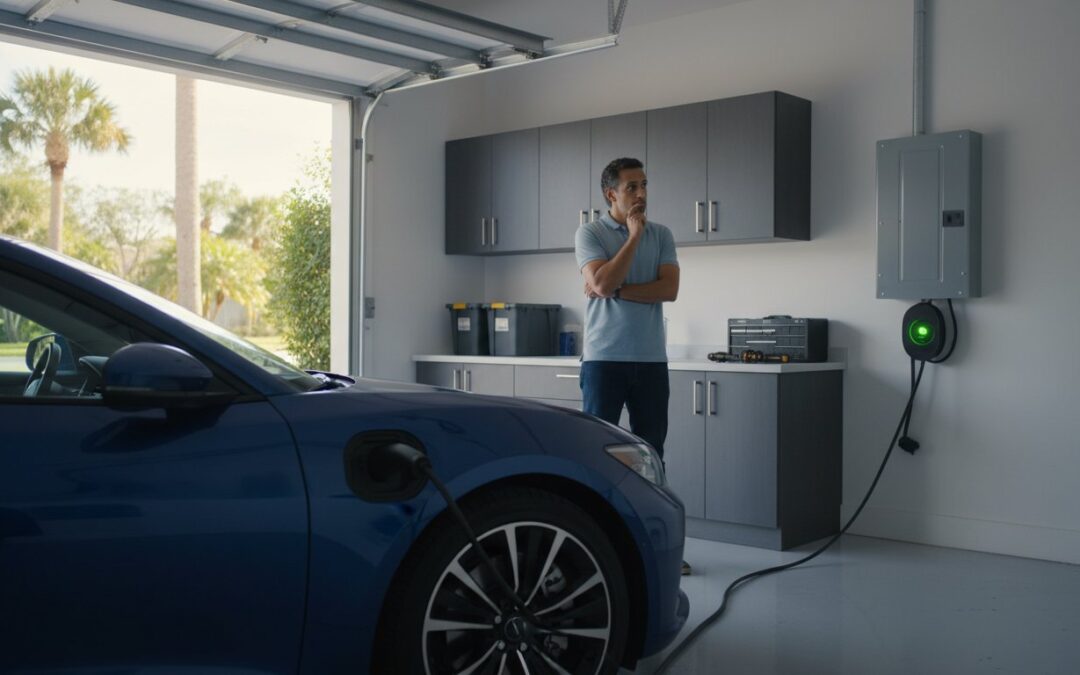
Approximately 20% of homeowners discover their electrical system cannot safely support a new Level 2 charging station without a significant modification. You might see empty spaces in your breaker box and assume you’re ready, but the vital question remains: is my electrical panel big enough for an EV charger in terms of actual amperage headroom? In Central Florida, where our air conditioning units already demand constant power, your panel’s capacity involves much more than just available physical slots.
It’s natural to feel concerned about the safety of your home or the potential for unexpected installation costs. Since 1925, Sanford Electric, LLC has helped neighbors navigate these technical transitions with professional reliability. We’ll show you exactly how to assess your home’s capacity and explain the 30% federal tax credit that expires on June 30, 2026. This guide provides a clear framework to determine if you need an upgrade, ensuring your transition to electric driving is both safe and compliant with the latest 2026 National Electrical Code standards.
Key Takeaways
- Identify the critical factors that help you answer the question, is my electrical panel big enough for an EV charger, by evaluating your home’s total amperage capacity.
- Understand how the heavy demand of Central Florida air conditioning systems impacts your available electrical headroom and charging safety.
- Recognize physical warning signs, like flickering lights or warm panels, that indicate your home needs a professional service upgrade.
- Discover how smart load management systems can help you avoid a full panel replacement by balancing power between your vehicle and large appliances.
- Learn why professional load calculations are essential for compliance with the 2026 National Electrical Code and long term home safety.
Amps vs. Slots: Understanding Your Panel’s True Capacity
Look inside your metal breaker box and you might see several unused plastic covers. While these look like invitations for new equipment, they don’t tell the full story of your home’s power limits. Many Orlando residents ask us, “is my electrical panel big enough for an EV charger just because I have two empty slots?” The answer depends on your total amperage capacity, not just your available physical space. Electrical capacity is the total simultaneous power draw your system can safely sustain.
To find your capacity, locate the main breaker at the very top or bottom of your electrical panel. This large switch acts as the gatekeeper for all the electricity entering your home. You will typically see a number stamped on the handle, such as 100, 150, or 200. This number represents the maximum Amps your home can pull from the grid at any single moment. If your home was built or renovated recently, you likely have 200-amp service, which provides the necessary headroom for modern high-draw appliances.
Safety standards require us to follow the “80% Rule” found in the National Electrical Code. Because an EV charger is a continuous load that runs for several hours, it should only utilize 80% of its circuit’s rated capacity. For example, a 50-amp breaker is required to safely deliver a 40-amp charge to your vehicle. This prevents the wires from overheating during the long hours your car sits in the garage overnight.
The Difference Between 100-Amp and 200-Amp Service
In 1925, when Sanford Electric, LLC first began serving Central Florida, a 60-amp or 100-amp panel was more than enough for a few light bulbs and a radio. Today, those same 100-amp panels struggle to keep up with modern life. While a 100-amp system might technically have room for an EV charger, it often lacks the headroom to run the charger while your water heater and clothes dryer are active. A 200-amp service is the modern gold standard. It provides the stability needed for an EV charger without risking a total system trip. In some cases, a 150-amp panel serves as a sufficient middle ground, provided your other electrical demands are relatively low.
Why ‘Empty Slots’ Can Be Deceiving
Physical space in a panel is often created using “tandem breakers,” which are thin switches that allow two circuits to fit into a single slot. This creates a false sense of security. You might have ten empty slots but zero remaining amperage capacity. Adding a 40A or 50A breaker to a panel that is already near its limit is a serious fire hazard. Visual signs of a maxed-out system include crowded, messy wiring or a panel that feels warm to the touch. Our technicians often see panels that look “full” because of the sheer volume of wires, even if the amperage hasn’t been exceeded yet. Professional load calculations are the only way to be certain is my electrical panel big enough for an EV charger before you begin the installation process.
The EV Load Calculation: Is There Enough ‘Headroom’?
Calculating your home’s total electrical load is the only way to answer the question, “is my electrical panel big enough for an EV charger?” This process involves more than just adding up the numbers on your breakers. We look for the “headroom,” which is the difference between your panel’s maximum capacity and the peak amount of power your home actually uses. In Central Florida, this calculation is unique because our environmental conditions place specific stresses on residential systems.
The first step involves a detailed inventory of your “heavy hitters.” These are the large appliances that draw significant power, including your electric water heater, clothes dryer, and oven. However, the most important factor in Orlando is the “AC Tax.” High humidity and temperatures often keep air conditioning units running for 10 hours or more per day during the summer. Because these units run for extended periods, they are considered continuous loads. This constant draw leaves less available capacity for your vehicle than a home in a cooler climate might have.
Calculating Your Current Electrical Demand
To get an accurate picture, we examine the nameplate ratings on your major appliances. These labels provide the exact wattage or amperage the device requires. A licensed electrician uses this data to perform a load study. This study accounts for peak demand, which typically occurs on a July afternoon when your AC is at full tilt while you are also cooking or doing laundry. Following the professional assessment and safety guidelines provided by the EPA ensures that your home remains within safe operating limits during these high-stress periods. For a truly accurate result, we follow the National Electrical Code (NEC) Standard or Optional calculation methods to determine your total existing load before suggesting any changes.
Adding the EV Charger to the Equation
Once we understand your current usage, we add the demand of your chosen Level 2 charger. Most home chargers pull between 32A and 48A. However, the NEC requires a 125% safety margin for continuous loads like EV charging. This means a 40A charger cannot simply use a 40A breaker; it requires a dedicated 50A circuit breaker to prevent overheating. If your current headroom is only 30 Amps, you will likely need a panel upgrade to accommodate the new vehicle. The charging speed you desire directly impacts this need. A faster 48-amp charger requires a 60-amp circuit, which puts even more pressure on your existing service. Determining is my electrical panel big enough for an EV charger is a vital safety step. If you are unsure about your home’s current capacity, a professional electrical safety inspection can provide the clarity you need before purchasing your vehicle.
Signs Your Central Florida Home Needs a Panel Upgrade
Beyond the technical load calculations discussed previously, your home often provides physical warnings that its system is struggling to keep pace. If you are asking, “is my electrical panel big enough for an EV charger,” you should first observe how your house behaves under its current load. A common red flag in Orlando is flickering lights that occur specifically when your air conditioning compressor kicks on. This indicates that the initial draw of the AC is momentarily starving other circuits of power. Frequent breaker trips are another sign that your system is operating at its limit and cannot handle the addition of a high-draw vehicle circuit.
Physical symptoms require immediate attention. If you notice a faint burning smell near your breaker box or if the panel cover feels warm to the touch, your system is likely experiencing arcing or significant over-resistance. These are not just inconveniences; they are critical fire hazards. The age of your equipment also matters. Most electrical panels have a reliable service life of about 25 years. If your home was built before 2001 and has never had a service upgrade, the internal components may be reaching the end of their dependable life cycle. For homeowners in this situation, electrical safety inspections in Orlando are the best way to verify system health before adding the high demand of an EV charger.
Dangerous Legacy Panels to Watch Out For
Certain brands of panels are known to be inherently dangerous and should be replaced regardless of your EV plans. Federal Pacific Electric (FPE) and Zinsco panels were installed in thousands of Central Florida homes between the 1950s and 1980s. These panels are notorious for “no-trip” breakers. This means that during an electrical fault, the breaker fails to shut off the power, which leads to melted wires and house fires. Sanford Electric, LLC has been identifying and replacing these hazards since 1925. If you see “Stab-Lok” or the Zinsco name on your panel, it is no longer a question of is my electrical panel big enough for an EV charger; the panel must be replaced for your safety.
The Impact of Florida’s Climate on Panel Longevity
Our local environment is particularly harsh on electrical infrastructure. High humidity and salt air, even miles inland, accelerate terminal corrosion. This corrosion increases electrical resistance, which generates unnecessary heat. In our 95-degree summers, this extra heat makes an undersized panel even more dangerous. Additionally, living in the “Lightning Capital of the World” means your panel faces frequent voltage surges. Without modern whole home surge protection and a robust, well-maintained panel, your expensive EV and its charging station are at risk. We approach every assessment with the deliberate care that comes from a century of experience in this unique climate.
Alternatives: Can You Avoid a Full Panel Upgrade?
If your load calculation shows your system is near its limit, you might not necessarily need a full service replacement. We often help clients explore alternatives that allow them to charge safely while staying within their current amperage. When determining is my electrical panel big enough for an EV charger, we look at Smart Load Management Systems (LMS). These devices monitor your home’s total power draw in real time. If your air conditioner and electric oven are both running, the LMS will automatically pause or slow your EV’s charging rate to prevent an overload. Once the other appliances cycle off, the charger resumes at full speed.
Another option is circuit sharing or switching. This involves a device that allows an EV charger to share an existing 240-volt circuit with a clothes dryer. The device prioritizes one appliance at a time, ensuring you never exceed the circuit’s capacity. For some Central Florida homeowners, simply downsizing the charger is the most practical solution. While a 48-amp charger is fast, a 16-amp or 24-amp Level 2 charger still provides 12 to 20 miles of range per hour. This lower draw often fits within the existing headroom of a 150-amp panel without requiring a major overhaul.
Smart Panels and Load Shedding
Modern smart breakers and panels allow for automated load shedding. This technology prioritizes essential circuits, like your refrigerator and AC, over the EV charger. While a 200-amp upgrade offers the most long term flexibility, these smart systems are an effective way to manage a 100-amp or 125-amp service. Our professional EV charger installation in Orlando includes an assessment of these smart options to see if they fit your specific needs. The 2026 National Electrical Code now recognizes these energy management systems as valid ways to satisfy load requirements without a physical panel upgrade.
Sub-Panels: When They Help and When They Don’t
There’s a common misconception that adding a sub-panel increases your home’s power. A sub-panel only adds more physical “slots” for breakers; it doesn’t increase the total amperage coming from the utility. If your main 100-amp service is already maxed out, a sub-panel won’t help. However, a sub-panel is an excellent choice for a detached garage or a workshop. It allows us to run one large set of wires to the garage and then distribute that power to the charger and lights locally. To find the right balance for your home, schedule a load management consultation with our team today. We’ve been solving complex capacity issues for our neighbors since 1925.
Taking the Next Step: Professional Assessment and Safety
DIY load calculations provide a helpful baseline, but they should never be the final word for home safety. Electricity involves inherent risks that require a seasoned eye to manage properly. When you ask, “is my electrical panel big enough for an EV charger,” you are asking about the stability of your home’s entire infrastructure. We’ve seen many cases where a panel looked adequate on paper but had hidden thermal damage or loose connections that only a professional evaluation could reveal. Our technicians arrive with the tools and experience to see what the average homeowner might miss.
During a Sanford Electric professional evaluation, we do more than just count breakers. Our technicians perform a physical inspection of the bus bars, check for signs of moisture intrusion common in Central Florida, and conduct a formal load study. This process ensures your new charger won’t cause nuisance tripping or heat-related failures. Investing in a residential electrical panel upgrade offers a significant long term return on investment. It increases your property value and prepares your home for future smart technologies beyond just the vehicle. It’s a move toward stability and peace of mind.
Permitting and Code Compliance in Central Florida
Local building departments in Sanford, Lake Mary, and Orlando require permits for all new EV charger circuits. This requirement isn’t just red tape; it’s a vital safety record for your property. Professional installation ensures your homeowner’s insurance remains valid if an electrical claim ever arises. Many insurance providers now specifically verify if high-draw appliances were installed by a licensed contractor according to local codes. Our team handles the entire permitting process for you. We ensure every connection meets the 2026 National Electrical Code standards, which is essential for your family’s protection.
The Sanford Electric Difference
We are a four-generation, family-owned business that has served this community since 1925. This longevity is built on a foundation of trust and technical proficiency. We don’t use aggressive sales tactics; instead, we provide functional, direct advice based on a century of experience. Our methodical approach prioritizes your family’s safety above all else. You can rely on our unshakeable commitment to high standards for every project, from a simple circuit addition to a full service upgrade. We’ve seen every possible electrical issue over the last hundred years. This experience allows us to integrate your EV charger into your home’s system with absolute precision. Contact us to schedule your comprehensive home energy audit today and move forward with confidence.
Preparing Your Home for the Next Generation of Travel
Determining if your electrical system is ready for a Level 2 charger involves more than checking for empty breaker slots. You must account for your home’s total amperage and the significant power demands of Central Florida’s climate. While smart load management or smaller chargers offer temporary alternatives, a robust 200-amp service remains the gold standard for long-term safety and efficiency. This upgrade ensures your property can handle the 125% safety margin required for continuous loads without risking system failure.
The final answer to “is my electrical panel big enough for an EV charger” requires a precise load calculation performed by a qualified professional. Since 1925, Sanford Electric, LLC has provided reliable, family-owned service to our neighbors. Our licensed and insured master electricians bring four generations of expertise to every home energy audit. Ensure your home is EV-ready with a professional panel assessment from Sanford Electric, LLC. We look forward to helping you transition to electric driving with the peace of mind that comes from a century of quality service.
Frequently Asked Questions
Can I install an EV charger on a 100-amp panel?
Yes, it’s possible to install a charger on a 100-amp panel, but it requires a strict professional load calculation first. Many 100-amp systems in Central Florida are already near their limit because of the high demand from air conditioning units. If your home has several electric appliances, you may need to use a load management device or upgrade to a 200-amp service to ensure safety.
How much does it cost to upgrade an electrical panel for an EV charger in Florida?
Based on 2026 industry data, a standard 200-amp panel replacement generally costs between $1,300 and $3,000. If your home requires a full service upgrade, including new wires from the utility, costs typically range from $2,000 to $5,000. These figures vary based on the complexity of the installation and any local permitting requirements in your specific municipality.
Will my EV charger trip my main breaker?
Your main breaker will trip if the total simultaneous power draw from your car, AC, and other appliances exceeds the panel’s rated capacity. This is why determining is my electrical panel big enough for an EV charger is a critical safety step. Without enough amperage headroom, running your dryer or oven while charging your vehicle can overload the entire system and shut down your power.
Do I need a permit to install an EV charger in Orlando?
Yes, most municipalities in Central Florida require an electrical permit for the installation of a new 240-volt circuit. Permit costs typically range from $50 to $300 depending on your location. This process ensures that the work is inspected and complies with the Florida Building Code and the latest National Electrical Code safety standards.
What is a load management device for EV charging?
A load management device is a smart system that monitors your home’s real-time electricity usage. It automatically adjusts or pauses your vehicle’s charging rate when other high-draw appliances, like your AC or water heater, are running. This technology is an excellent alternative for homeowners who want to avoid the cost of a full panel upgrade while maintaining system stability.
How do I know if my electrical panel is 100 or 200 amps?
You can find your panel’s amperage by looking at the main breaker switch, which is usually located at the very top or bottom of your breaker box. This switch is typically larger than the others and will have a number like 100, 150, or 200 stamped on the handle. This number represents the maximum capacity of your home’s electrical service.
Can I use a Level 1 charger permanently to avoid a panel upgrade?
You can use a Level 1 charger permanently, but it is very slow and only adds about 3 to 5 miles of range per hour. This means it could take over 24 hours to fully charge a modern EV battery. While it avoids the need for a panel upgrade, most drivers find that a Level 2 charger is necessary for practical, overnight charging.
Is my panel too old for an EV charger if it was installed in the 1980s?
A panel from the 1980s is now over 40 years old and may be reaching the end of its dependable life. Many panels from that era were not designed for the heavy electrical loads of modern homes. We recommend a professional evaluation to determine is my electrical panel big enough for an EV charger and to check for any signs of wear or outdated components that could pose a fire risk.