HVAC Electrical Wiring in Sanford & Orlando: The 2026 Homeowner’s Guide
Mar 7, 2026
Imagine it’s a 98-degree Saturday in Sanford, and your air conditioner suddenly cuts out just as the humidity hits 90 percent. You check the panel only to find a tripped breaker for the third time this week. This scenario isn’t just frustrating; it’s a clear signal that your HVAC system’s electrical wiring in Florida is struggling to manage modern cooling demands. Since 1925, Sanford Electric Co. II, Inc. has observed how inadequate circuits lead to more than just temporary discomfort. They frequently result in premature equipment failure or hazardous electrical fires.
You deserve a home that stays cool without the constant worry of a power interruption. This guide outlines the critical electrical requirements for Florida HVAC systems and explains why professional wiring is the backbone of your cooling efficiency. We’ll clarify the specific roles of HVAC technicians versus licensed electricians so your 2026 project passes every local inspection in Orlando or Sanford. You will discover how to protect your significant financial investment with a system that operates safely through the most intense summer peaks.
Key Takeaways
Understand why Florida’s extreme climate demands a specialized high-voltage infrastructure to maintain long-term cooling efficiency.
Identify the critical role of electrical disconnects and properly sized circuit breakers in preventing hazardous system overloads and equipment failure.
Navigate the legal and safety requirements for hvac electrical wiring florida to ensure your high-voltage connections are handled by a licensed professional.
Prepare for the 2026 building code updates, including mandatory surge protection requirements that safeguard your home’s expensive HVAC investment.
Discover the peace of mind that comes from a methodical safety inspection performed by a local team with a legacy of service dating back to 1925.
What is HVAC Electrical Wiring and Why is it Critical in Florida?
At Sanford Electric Co II, Inc., we’ve maintained the power grids of local homes since 1925. To understand your home’s cooling system, you must first understand its lifeline: the Heating, ventilation, and air conditioning (HVAC) electrical wiring. This infrastructure consists of the high-voltage lines that deliver 240 volts of electricity to your exterior compressor and interior air handler. In Central Florida, these components work harder than almost anywhere else in the country. While a system in the Midwest might run for 1,100 hours annually, a typical unit in Sanford or Lake Mary often exceeds 2,800 hours of operation per year. This constant load places immense pressure on hvac electrical wiring florida homeowners rely on for daily comfort.
High-voltage supply lines are distinct from the low-voltage wires connecting your thermostat. Your thermostat operates on a mere 24 volts to send signals, but the supply lines carry the heavy amperage required to start a 5-ton compressor. When this wiring is sized incorrectly or suffers from loose connections, your system draws more current than necessary. This inefficiency can increase your monthly energy bill by 12% to 18% and eventually lead to the premature burnout of your compressor motor. Replacing a compressor can cost upwards of $2,500, making professional wiring a primary safeguard for your investment.
The Role of the Dedicated Circuit
Every modern cooling system requires a dedicated circuit. This means the breaker in your panel serves the HVAC unit and nothing else. Sharing a circuit with a water heater or a kitchen appliance leads to frequent trips and potential fire hazards. Since the Department of Energy updated SEER2 efficiency standards on January 1, 2023, modern 2026-ready units demand precise ampacity. If your home still uses the 10-gauge wire from a 1990s installation for a high-efficiency 5-ton unit, you risk overheating. In Sanford, attic temperatures frequently hit 140 degrees Fahrenheit. This ambient heat reduces the current-carrying capacity of the wire, meaning that improperly gauged wiring will degrade much faster than it would in a climate-controlled space.
Environmental Stressors in Central Florida
Central Florida presents a unique set of challenges for electrical components. In Volusia County and coastal-adjacent areas, salt-laden air accelerates the corrosion of copper terminals and aluminum fins. Humidity levels consistently exceeding 75% can cause moisture to collect inside electrical conduits, leading to short circuits or “arcing.” We often see junction boxes that have rusted through in less than 9 years because of this relentless moisture. Thermal degradation is the gradual breakdown of insulation and conductive materials caused by prolonged exposure to high operating temperatures and solar radiation. Our team has provided quality service since 1925, and we know that using weather-rated, liquid-tight conduits is the only way to ensure your hvac electrical wiring florida system survives the local environment.
Safety: Properly installed wiring prevents electrical fires in high-heat environments.
Longevity: Correct wire sizing prevents the 20% reduction in equipment life caused by voltage drops.
Compliance: Professional installations ensure your home meets the latest National Electrical Code (NEC) standards.
Essential Components of a Safe HVAC Electrical Installation
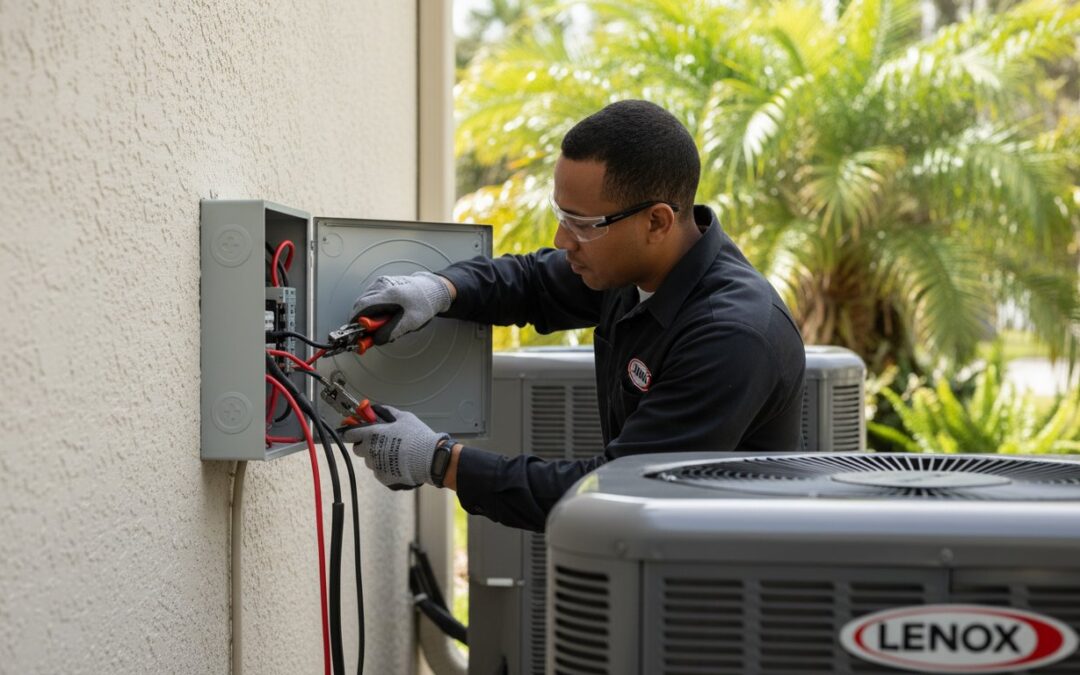
Safety is the foundation of every project we undertake at Sanford Electric Co. II, Inc. Since 1925, our family-owned business has seen how Florida’s harsh environment can degrade even the most robust systems. A professional hvac electrical wiring florida installation isn’t just about making the unit run; it’s about ensuring the system remains stable under the intense electrical loads required to cool a home in 95-degree humidity. The electrical disconnect serves as the primary safety lifeline. This specialized switch box allows a technician to cut power instantly before performing maintenance. National safety standards require this box to be within a direct line of sight of the unit to prevent accidental energization while someone is working on the internal components.
Precision matters when matching circuit breakers to your equipment. We strictly follow the manufacturer’s Maximum Overcurrent Protection (MOP) rating found on the unit’s nameplate. If a condenser specifies a 35-amp maximum fuse, installing a 40-amp breaker creates a fire hazard. The breaker must be sized to protect the sensitive compressor windings from internal faults. Our team ensures that 100% of our installations align with the updated Florida Building Code requirements, which clarify the specific licensing and safety protocols necessary for complex hvac electrical wiring florida projects. Proper protection also extends to the physical wires. We utilize liquid-tight flexible conduit, often called a “whip,” to shield conductors from the intense UV radiation that defines our local climate.
Grounding and bonding are non-negotiable in the “Lightning Capital of the US.” Central Florida experiences over 70 lightning strikes per square mile annually in some counties. Without a dedicated copper grounding path, a nearby strike can send a surge through your HVAC system, frying the control boards instantly. We verify that every component is bonded to the home’s main grounding electrode system to provide a safe path for fault current. If you’re concerned about your current setup, our technicians can perform a safety evaluation of your electrical panels to ensure everything is up to modern standards.
The Outdoor Condenser Connection
Orlando storms bring horizontal rain and high winds. We install weatherproof “In-Use” covers that protect electrical connections even when the system is under heavy load during a downpour. To prevent damage from standing water during a typical 3-inch afternoon rain event, we ensure all electrical boxes are mounted at a minimum height of 12 inches above the finished grade. Flexible conduit is essential here; it dampens the 60Hz vibrations from the compressor, preventing wires from rubbing against metal edges and shorting out over time.
Indoor Air Handler Wiring
The indoor air handler often houses electric heat strips used for emergency heating or defrost cycles. These strips can pull between 5kW and 20kW of power, requiring heavy-gauge wire and dedicated high-amp circuits. We also integrate primary and secondary condensate overflow switches directly into the low-voltage control wiring. These sensors are calibrated to shut down the system if the drain line clogs, preventing the 20 to 30 gallons of water an AC can produce daily from flooding your home. Modern ECM blowers also require circuits that can handle a high initial startup surge without tripping the breaker, a common issue in older Sanford homes.
HVAC Tech vs. Licensed Electrician: Who Should Do the Wiring?
Homeowners often assume an HVAC technician handles every aspect of a new system installation. It’s a common mistake that can lead to code violations or safety hazards. While these professionals are experts in refrigerant lines and airflow, Florida law draws a clear line at the electrical panel. Forcing an HVAC installer to perform complex electrical work outside their licensed scope puts your home at risk. Professional hvac electrical wiring florida requires a specific set of credentials to ensure the high-voltage side of the system operates safely for decades.
Florida Statute 489.105 defines the limits of what an HVAC contractor can legally touch. Recent legislative updates, specifically those found in the Florida Building Code Requirements, clarify that while HVAC contractors can handle certain disconnects, they cannot modify the home’s permanent electrical distribution system. If your installation requires a new circuit or a panel upgrade, a licensed electrical contractor must pull the necessary permits. This division of labor isn’t just about red tape; it’s about fire prevention and system longevity.
Your manufacturer’s warranty also depends on this distinction. Major brands like Carrier or Trane frequently require proof that a licensed electrician performed the high-voltage connections to honor a 10-year parts warranty. If a failure occurs and the manufacturer finds the hvac electrical wiring florida was installed by an unlicensed individual, they may deny your claim. Sanford Electric Co. II has provided this essential oversight since 1925, ensuring that your investment remains protected by both the law and the manufacturer.
When an HVAC Tech is Sufficient
You don’t always need a master electrician for minor component replacements. An HVAC technician is perfectly qualified to handle low-voltage tasks, such as wiring a 24-volt smart thermostat or replacing internal components like a 45-microfarad capacitor. They can also reconnect an existing electrical whip to a new unit if the amperage and wire gauge remain identical to the previous system. These tasks fall under standard maintenance and direct unit replacement protocols.
When You MUST Call Sanford Electric Co II
Complex infrastructure changes require our specialized expertise. If you are upgrading from a 3-ton to a 5-ton unit, your existing 100-amp panel might require an upgrade to 200 amps to handle the increased load. We also handle the installation of dedicated 240-volt circuits for new mini-split systems in garages or attics. Furthermore, if your home was built between 1965 and 1972, you likely have aluminum wiring. We must remediate these connections using AlumiConn connectors or COPALUM crimps before a new HVAC system is energized to prevent terminal overheating and potential fires.
Our family-owned business has seen every iteration of Florida’s electrical code over the last 99 years. We bring a level of discipline and technical proficiency that protects your family. When you choose Sanford Electric Co. II, you aren’t just hiring a contractor; you are partnering with a Central Florida institution that has prioritized safety and quality service since 1925.
Florida Building Code & Safety Requirements for 2026
The 2026 Florida Building Code updates demand higher precision for hvac electrical wiring florida than ever before. Since 1925, our team has monitored these regulatory shifts to ensure every installation remains compliant and safe for your family. One major shift involves mandatory surge protection. Under the latest NEC standards, all new and replaced HVAC systems must have a dedicated surge protective device (SPD) to shield sensitive control boards from voltage spikes. Additionally, the code mandates strict working clearances. You must maintain a clear area at least 30 inches wide and 36 inches deep in front of your outdoor disconnect and indoor electrical panel. This space allows technicians to work safely without obstructions, a detail that inspectors in Seminole and Orange Counties verify during every final site visit.
Permitting requirements have also tightened as we move into 2026. In Seminole County, any new HVAC circuit exceeding 50 volts requires a standalone electrical permit. Orange County typically bundles this under a mechanical permit, but the electrical sub-permitting must detail the wire gauge and breaker sizing. We also prioritize AFCI (Arc-Fault Circuit Interrupter) and GFCI (Ground-Fault Circuit Interrupter) protection in specific residential zones. If your HVAC equipment or air handler is located in a garage, crawl space, or laundry area, the 2026 code requires specialized protection to prevent electrical fires and shock hazards. Our technicians handle these technical hurdles so you don’t have to worry about failed inspections or safety risks.
Local Code Nuances: Sanford vs. Orlando
In downtown Sanford and Winter Park, historical home wiring requires a specialized approach. These structures often feature lath and plaster walls or outdated panels that cannot support the 30 to 50-amp loads required by modern cooling systems. When we upgrade hvac electrical wiring florida in these historic districts, we focus on non-destructive installation methods to preserve the home’s character. Inspectors in Orlando often focus on high-density residential standards, while Sanford officials emphasize structural preservation alongside modern safety. Per the 2026 NEC 240.24 requirement, all breakers must be installed so the center of the grip of the operating handle is no more than 6 feet 7 inches above the floor to ensure immediate accessibility during an emergency.
Surge Protection: A Florida Necessity
Central Florida experiences more than 1.2 million lightning strikes annually, making electrical protection a necessity rather than an upgrade. Modern AC units rely on delicate microprocessors that can fail during a standard afternoon thunderstorm. Investing in Whole Home Surge Protection in Sanford is the most reliable way to secure your equipment. A typical high-efficiency HVAC system costs upwards of $10,000 today. Spending roughly $300 on a high-quality Type 1 or Type 2 surge protector provides a massive return on investment by preventing fried circuit boards. We’ve seen hundreds of systems lost to surges that a simple, code-compliant device could have prevented. Our family-owned business treats your home’s safety with the same level of care we’ve provided for over a century.
Sanford Electric Co. II, Inc. has served as a cornerstone of the Central Florida community for 99 years. Since 1925, our family-owned and operated business has passed down technical expertise through four generations. This deep history provides us with a unique perspective on the local electrical landscape. We don’t just pull wires; we maintain a legacy of safety and reliability that began nearly a century ago. Our team understands how the intense Florida humidity and frequent lightning strikes affect residential power systems differently than in other regions. This local knowledge allows us to design electrical solutions that stand up to the specific environmental demands of our state.
Safety is the foundation of every project we undertake. We utilize a methodical 32-point safety inspection for every HVAC electrical audit. Our technicians examine wire gauge compatibility, verify terminal torque settings to prevent arcing, and inspect the integrity of weather-tight seals on all exterior disconnect boxes. In 2023, our inspections identified that 18% of older homes had undersized conductors or corroded connections that could have led to system failure. We catch these vulnerabilities before they turn into emergency repairs. Our goal is to provide you with a stable electrical foundation that protects your expensive cooling equipment and your family.
We believe that professional service should be accessible and predictable. Our service area spans from the growing neighborhoods in Lake Mary to the established estates in Windermere. We prioritize transparent pricing by providing flat-rate quotes before any work begins. You won’t find hidden fees or travel surcharges on your bill. We treat every home with the same level of care, whether we’re performing a minor repair or a complete heavy-up on a 200-amp service panel. Our reputation in the community is built on this consistency and our refusal to cut corners.
Expertise You Can Count On
Our commitment to “Quality Service Since 1925” is visible in every circuit we install. Local builders and HVAC contractors rely on us for complex projects because they know we understand the intricacies of the Central Florida grid. You get direct access to master electricians who have managed large-scale industrial and residential projects for over 30 years. We ensure your hvac electrical wiring florida installation meets all current National Electrical Code standards and local municipal requirements. This technical precision prevents common issues like premature compressor wear or tripped breakers during peak summer loads.
Ready to Secure Your Home’s Comfort?
Professional wiring is a non-negotiable requirement for any Florida home. The proper hvac electrical wiring florida homeowners require must account for high heat and heavy usage cycles that can degrade insulation over a 10-year period. A single loose neutral or an improperly grounded wire can destroy a $6,000 high-efficiency condenser in a matter of seconds. Don’t wait for the first 95-degree day in May to discover a problem with your electrical panel or HVAC dedicated circuit. If your home is more than 25 years old, or if you’ve noticed flickering lights when your AC kicks on, it’s time for a professional assessment.
Review your current electrical panel capacity for 240-volt dedicated circuits.
Identify signs of UV degradation or heat damage on exterior wiring.
Confirm that your surge protection is rated for the high-frequency strikes common in Central Florida.
Maintaining a reliable cooling system in the Sunshine State requires more than just a functional compressor. Proper installation and strict adherence to the 2026 Florida Building Code ensure your system operates safely during peak summer heat. Entrusting your home’s power to a licensed professional prevents common hazards like overloaded circuits or improper grounding. Our Licensed and Insured Master Electricians bring technical precision to every project; we’ve been refining our craft since 1925.
When you choose Sanford Electric Co. II, Inc., you’re partnering with a family-owned and operated business that’s served Central Florida for 101 years. We specialize in complex hvac electrical wiring florida projects that demand specialized knowledge beyond a standard repair. Our team provides the stability and expertise needed to protect your investment and your family. We currently serve Sanford, Orlando, and all of Central Florida with a commitment to quality that hasn’t wavered since our founding in 1925.
Does a new HVAC system require a dedicated electrical circuit in Florida?
Yes, the National Electrical Code and Florida Building Code require a dedicated circuit for all HVAC installations. This ensures the 30 to 60 amps needed for operation don’t overload other household outlets or trip shared breakers. Sanford Electric Co. II, Inc. has followed these safety standards since 1925 to prevent fire hazards. Proper hvac electrical wiring florida setups must include a dedicated breaker to maintain system stability during the peak summer humidity.
Why does my AC breaker keep tripping during the hottest part of the day?
Your breaker trips because the compressor draws excessive current when outdoor temperatures exceed 95 degrees. High heat increases resistance in the motor windings, often causing the unit to pull 15% more power than its rated capacity. This safety mechanism prevents the wire insulation from melting or catching fire. If your 20-year-old breaker fails to hold the load, it requires a professional inspection to ensure your home remains safe and functional.
What is the average cost for HVAC electrical wiring in Orlando?
Homeowners in Orlando typically pay between $350 and $900 for standard HVAC electrical wiring services. This price includes the installation of a new 240-volt circuit and a weather-proof disconnect box near the condenser. Costs can increase by $1,500 if your existing electrical panel lacks the physical space for a double-pole breaker. Our family-owned team provides transparent estimates based on 99 years of local experience in the Central Florida region.
Can I use my old electrical disconnect for a new high-efficiency AC unit?
You shouldn’t reuse an old disconnect if its amperage rating is lower than the new unit’s Minimum Circuit Ampacity. Most modern 16 SEER2 systems require a 30-amp or 60-amp fused disconnect to protect sensitive electronic control boards. Older boxes installed before 2010 often show signs of terminal corrosion that can cause dangerous voltage drops. Replacing this $50 component ensures your high-efficiency investment operates at peak performance without interruption.
Do I need a permit for HVAC electrical wiring in Sanford, FL?
Yes, the City of Sanford Building Department requires a permit for all new hvac electrical wiring florida projects. According to local code, any modification to the permanent wiring of a residential structure must be inspected by a licensed official. This process verifies that the installation meets the 2023 Florida Building Code standards. We handle the permit paperwork for our clients to ensure every job is documented and legally compliant with municipal safety regulations.
How does surge protection help my HVAC system during Florida lightning storms?
Surge protectors divert excess voltage, often exceeding 20,000 volts during a strike, away from your AC’s control board. Central Florida experiences over 70 lightning strikes per square mile annually, making this a critical safety feature for homeowners. A Type 2 surge device installed at the disconnect box can save you the $1,200 cost of replacing a fried inverter or compressor. It’s a small investment that provides long-term peace of mind during our storm season.
What size wire is required for a 5-ton air conditioning unit?
A 5-ton air conditioning unit generally requires 6-gauge or 8-gauge copper wire depending on the circuit breaker size. Most 5-ton systems utilize a 50-amp or 60-amp breaker, which necessitates the thicker 6-gauge wire to handle the current without overheating. Using 10-gauge wire on a 5-ton system is a code violation that can lead to a house fire. Our technicians always verify the manufacturer’s data plate before selecting materials for your project.
Is it safe to have my HVAC technician upgrade my electrical panel?
It’s only safe if the technician holds a valid Florida Master Electrician license and the proper insurance. While many HVAC contractors understand basic wiring, an electrical panel upgrade involves the main service entrance and requires specialized knowledge of load calculations. Sanford Electric Co. II, Inc. has specialized in these complex upgrades since 1925. Trusting a dedicated electrical professional ensures your panel meets the 200-amp standard required for modern Florida homes.
Categories
Archives
Manage Consent
To provide the best experiences, we use technologies like cookies to store and/or access device information. Consenting to these technologies will allow us to process data such as browsing behavior or unique IDs on this site. Not consenting or withdrawing consent, may adversely affect certain features and functions.
Functional
Always active
The technical storage or access is strictly necessary for the legitimate purpose of enabling the use of a specific service explicitly requested by the subscriber or user, or for the sole purpose of carrying out the transmission of a communication over an electronic communications network.
Preferences
The technical storage or access is necessary for the legitimate purpose of storing preferences that are not requested by the subscriber or user.
Statistics
The technical storage or access that is used exclusively for statistical purposes.The technical storage or access that is used exclusively for anonymous statistical purposes. Without a subpoena, voluntary compliance on the part of your Internet Service Provider, or additional records from a third party, information stored or retrieved for this purpose alone cannot usually be used to identify you.
Marketing
The technical storage or access is required to create user profiles to send advertising, or to track the user on a website or across several websites for similar marketing purposes.