
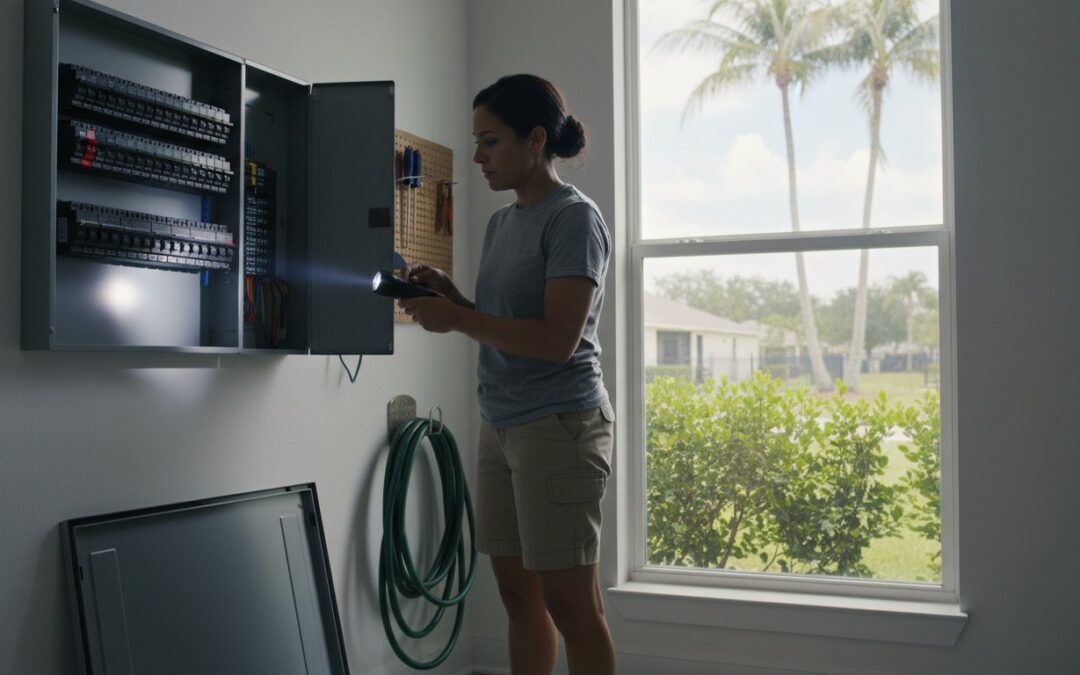
That sudden “click” from your electrical panel isn’t a sign that your system has failed; it’s proof that your home’s safety features are working exactly as they should. While losing power to your refrigerator or air conditioner is a major inconvenience, the breaker trips to prevent wires from overheating and starting a fire. If you are trying to fix tripping breaker Sanford issues, the goal isn’t just to restore power, but to ensure your home remains a safe place for your family.
It’s natural to feel concerned about the cost of repairs or the complexity of modern electrical jargon. Since 1925, Sanford Electric, LLC has provided reliable guidance to our Central Florida neighbors through every shift in technology and building standards. This guide will help you identify why your circuit keeps cutting out and how to safely troubleshoot the root cause. We will explain the difference between a simple circuit overload and more dangerous faults, giving you the knowledge you need before you call a professional Sanford electrician.
Key Takeaways
- Understand that a tripping breaker is a critical safety mechanism designed to prevent electrical fires and protect your home’s wiring.
- Learn the systematic steps to safely identify and fix tripping breaker Sanford issues caused by common circuit overloads.
- Discover how Central Florida’s unique environmental factors, including high humidity and lightning, impact the longevity of your electrical panel.
- Identify the specific warning signs that indicate a dangerous electrical fault requiring professional intervention rather than a simple reset.
- Recognize when a professional panel upgrade is the most dependable long-term solution for maintaining a safe and efficient modern home.
Why Your Circuit Breaker Keeps Tripping: Understanding the Safety Mechanism
A circuit breaker functions as the primary safety gatekeeper for your home’s electrical system. It monitors the flow of electricity to prevent disaster. When people ask What is a circuit breaker? they often learn it is an automatically operated electrical switch designed to protect an electrical circuit from damage. If you’re trying to fix tripping breaker Sanford issues, you first need to understand that the “trip” is a deliberate, protective action. It stops the flow of current before wires can overheat, melt, or cause a fire. Since 1925, our team at Sanford Electric, LLC has seen how these simple mechanisms prevent countless home tragedies across Central Florida.
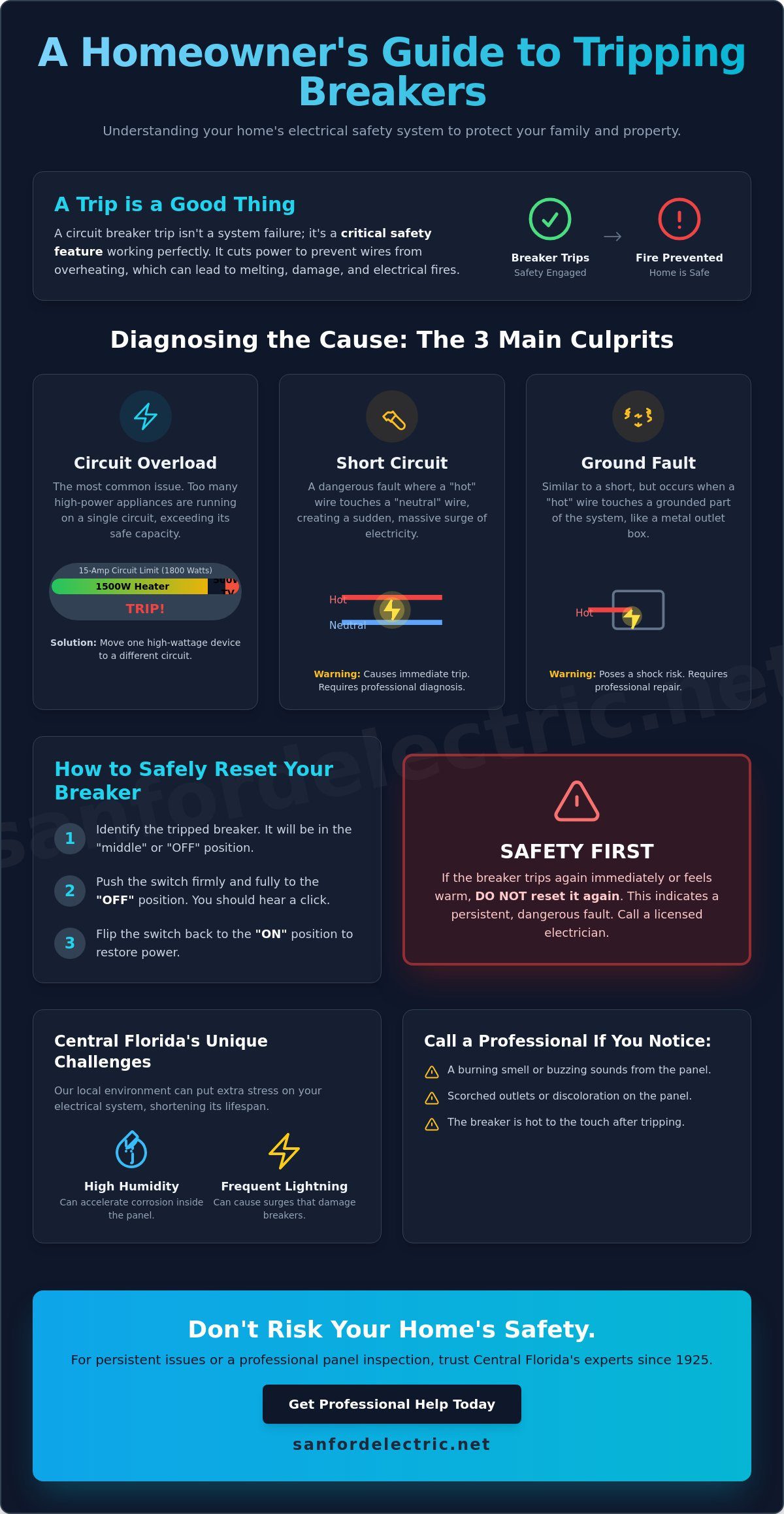
There is a major difference between a nuisance trip and a critical shutdown. A nuisance trip might happen if you use a high-wattage appliance on a circuit already powering other electronics. A critical shutdown occurs when the system detects a life-threatening fault. Most issues stem from three categories: circuit overloads, short circuits, and ground faults. Understanding these distinctions is the first step toward a permanent solution that keeps your family safe and your power stable.
The Anatomy of an Electrical Trip
Breakers use two primary methods to detect trouble. For a slow overload, the breaker relies on a bimetallic strip that bends as it heats up. Once the strip reaches a specific temperature, it physically pulls the lever to the off position. A sudden, violent short circuit triggers a magnetic response instead. This happens almost instantly to prevent an explosion or localized fire. The “trip point” is the safety threshold of your specific breaker amperage, such as 15 or 20 amps, which marks the absolute limit of what your home’s wires can safely handle.
Resetting the Breaker: The Right Way
Restoring power requires a specific sequence to ensure the internal mechanism engages correctly. Follow these steps for a safe reset:
- Identify the breaker that has moved to the “middle” or “off” position.
- Move the switch firmly to the full “OFF” position. You should feel or hear a distinct click.
- Flip the switch back to the “ON” position.
Safety is the priority here. Never force a breaker to stay in the on position if it resists or immediately flips back. This resistance is a clear signal that the safety hazard still exists. If the breaker trips again immediately after a reset, it indicates a persistent fault that requires a professional inspection to keep your property safe. Our family-owned business has provided this level of dependable care for over a century, ensuring every home we visit meets the highest standards of electrical integrity.
Diagnosing the Cause: Overloads, Short Circuits, and Ground Faults
When you encounter a power failure, a systematic approach is the most effective way to restore stability. Most homeowners can identify the source of the trouble by using a simple process of elimination. While many issues are minor, others require professional expertise to maintain safety. For broader context on how these systems fail, the U.S. Consumer Product Safety Commission provides official safety information for consumers regarding older panel risks. Since 1925, we’ve found that educating our neighbors on these diagnostic steps helps them manage their homes with confidence.
Identifying a Circuit Overload
Overloads are the most common reason people need to fix tripping breaker Sanford residents often find that their electrical capacity hasn’t kept pace with modern appliance demands. The math is straightforward. A standard 15-amp circuit supports approximately 1,800 watts. If you run a 1,500-watt space heater and a 500-watt television on the same line, the breaker will eventually trip to protect the wiring from heat damage.
In Central Florida, common culprits include high-draw devices like window AC units, hair dryers, and kitchen appliances. You’ll often see warning signs before the power cuts out. If your lights dim when the microwave starts, or if the breaker only trips after several minutes of use, you’re likely dealing with an overload. Moving one high-wattage device to a different circuit often solves the problem without further intervention.
Short Circuits and Ground Faults
Short circuits and ground faults represent a higher level of safety risk. A short circuit occurs when a “hot” wire makes direct contact with a “neutral” wire or another “hot” wire. This creates an immediate surge of energy. A ground fault is similar but happens when a “hot” wire touches a grounding component, such as the metal box of an outlet or a water pipe. These are particularly common in Sanford kitchens and bathrooms where moisture is present.
You can perform an “Immediate Trip” test to narrow down the cause. Unplug every device on the affected circuit and reset the breaker. If it trips instantly without anything plugged in, you have a wiring issue within your walls or the outlet itself. This is a critical safety hazard that requires a professional electrical safety inspection to prevent a potential fire. Our family-owned business has used these diagnostic methods for over a century to provide dependable results for the Central Florida community.
Local Electrical Challenges: Why Sanford Homes Experience Frequent Breaker Issues
Living in Central Florida presents unique environmental hurdles for residential electrical systems. While homeowners in other regions might only worry about overloaded circuits, residents here must contend with extreme humidity and the highest frequency of lightning strikes in the nation. These factors often lead to premature wear on protective devices. For those trying to fix tripping breaker Sanford issues, understanding the local climate is just as vital as Understanding Fuses and Circuit Breakers and how they serve as your home’s first line of defense.
Our community features a diverse range of housing, from the beautiful historic properties in downtown Sanford to the sprawling 1980s and 90s developments in Lake Mary. Each era brings its own infrastructure challenges. Older homes may still utilize aluminum wiring or outdated panels that were never designed for the modern load of electric vehicles and smart appliances. When combined with the corrosive nature of Florida air, these systems can become unreliable and even dangerous over time. Our family-owned business has navigated these local complexities since 1925, providing the technical expertise needed to keep these varied systems running safely.
The Humidity and Corrosion Factor
High moisture levels in the air lead to oxidation on the metal contacts within your electrical panel. This oxidation creates electrical resistance, which generates unnecessary heat. Since heat is the primary trigger for most breakers, a corroded connection can cause a “nuisance trip” even when the circuit isn’t overloaded. You might notice a faint buzzing or humming sound coming from your panel; this is often the sound of electricity struggling to pass through oxidized components. To ensure your system remains stable, we recommend a professional electrical safety inspection for any home older than 20 years. We know exactly where corrosion hides in local panels because we’ve been servicing them for over a century.
Lightning and Power Surges in Central Florida
Florida’s reputation as the lightning capital of the United States isn’t just a weather statistic. It is a daily reality for our electrical grid. While a direct strike is rare, frequent indirect strikes send small surges through the utility lines. These repeated “micro-surges” degrade the internal springs and sensitive components of your circuit breakers. Over time, the breaker becomes “weak,” meaning it will trip at much lower levels than its rated capacity. Installing whole home surge protection is a dependable way to shield your sensitive electronics and the panel itself from these environmental stresses. Protecting your home from the ground up ensures peace of mind during our intense summer storm seasons.
Safety First: Warning Signs That Require an Emergency Electrician
While we have discussed how to diagnose an overloaded circuit, there are critical moments when you must step away from the electrical panel. Most homeowners attempt to fix tripping breaker Sanford issues by simply unplugging a toaster or a space heater. However, if the root cause is a structural failure within your wiring or the panel itself, resetting the switch can actually increase the risk of an electrical fire. Since 1925, our technicians have seen how a “nuisance” trip can quickly escalate into an active fire hazard if these warning signs are ignored.
Internal panel work is not a project for a weekend DIY enthusiast. Your electrical panel manages high-voltage current that can cause severe injury or property damage if handled incorrectly. If you encounter any of the following conditions, the systematic troubleshooting we covered earlier no longer applies. You need a licensed professional to verify the integrity of your home’s safety systems. Our family-owned business prides itself on providing the peace of mind that comes from a century of technical expertise in Central Florida.
The “Smell and Touch” Test
Your senses are powerful tools for identifying electrical danger. An unusual odor resembling ozone or burning plastic is a significant red flag. This scent indicates that the plastic insulation on your wiring is melting due to extreme heat. You should also check the physical temperature of the panel cover. While some electrical components generate slight warmth, a panel should never feel hot to the touch. If you notice scorch marks on the breaker or melted casing around the wires, do not attempt to reset the system. These are visual indicators of an arc or a severe short circuit that has already caused physical damage to your hardware.
Recurring Trips and Unresponsive Breakers
Circuit breakers are mechanical devices with a finite lifespan. They rely on internal springs and sensors that eventually wear out. A breaker that trips three or more times in a single week is a clear cry for a panel upgrade. This frequency suggests that the breaker is no longer calibrated correctly or that your home’s electrical demand has permanently outpaced the panel’s capacity. Perhaps the most dangerous sign is a breaker that won’t reset at all or feels “spongy” when you flip the switch. This indicates an internal mechanical failure. Forcing a failed breaker to stay in the on position bypasses your home’s primary safety gatekeeper and creates a direct path for a fire to start.
If your electrical panel is showing these signs of distress, the most dependable path forward is a professional assessment. You can reach out to our team for a comprehensive electrical safety inspection to ensure your Sanford home remains a safe haven for your family.
Professional Solutions: Panel Upgrades and Repairs in Central Florida
While basic troubleshooting can resolve a simple circuit overload, persistent electrical issues often point to a deeper capacity problem. If you find yourself repeatedly trying to fix tripping breaker Sanford issues, it is time to consider a long-term solution. A modern home in 2026 operates differently than a home built even twenty years ago. Our team at Sanford Electric, LLC provides the technical expertise to transition your home from an outdated, struggling system to a robust and safe electrical foundation. We believe in solving the root cause of your power failures rather than just treating the symptoms.
Every repair we perform includes a comprehensive safety inspection. We don’t just reset a switch; we evaluate the integrity of your panel, the tightness of your connections, and the condition of your wiring. This methodical approach is the standard we have maintained since our founding in 1925. By identifying hidden risks like loose lugs or oxidized bus bars, we prevent future emergencies and provide the peace of mind every Central Florida homeowner deserves.
Modernizing Your Home’s Power
Many homes in our area still operate on 100-amp service panels. These older systems were standard for decades, but they struggle to manage the 2026 appliance loads of a modern household. Between high-efficiency HVAC units, smart home ecosystems, and the increasing demand for EV charger installation, 100 amps is often insufficient. Upgrading to a 200-amp panel is a strategic investment that offers a significant return. It enhances your family’s safety, ensures compliance with the 9th Edition of the Florida Building Code, and can even lower insurance premiums for older properties. A higher-capacity panel allows your home to grow with your technology needs without the constant frustration of power interruptions.
The Sanford Electric Difference
Sanford Electric, LLC is a pillar of the Central Florida community. We are a family-owned and operated business that has spanned four generations. This legacy of service means we approach every job with neighborly accountability and a deep sense of professional pride. Our commitment to “Quality Service Since 1925” is more than a tagline; it is our verbal seal of approval on every project we handle. We have seen every evolution of electrical technology over the last century, and we bring that quantifiable experience to your home. When you choose us, you are choosing a seasoned expert who prioritizes stability, safety, and proven results.
Do not wait for a minor nuisance to become a major safety hazard. Our technicians are ready to evaluate your system and provide a dependable path to a more reliable home. Contact Sanford Electric for a professional panel evaluation today.
Secure Your Home’s Electrical Future
Your home’s electrical panel is more than just a box of switches; it’s a sophisticated safety system designed to protect your family. Understanding how to fix tripping breaker Sanford issues starts with recognizing when an overload is a simple fix and when it signals a deeper infrastructure problem. Whether you’re dealing with the corrosive effects of Florida’s humidity or the increased demands of modern appliances, maintaining a stable power supply requires a proactive approach to safety.
Sanford Electric Co. II, Inc. has served as a trusted local anchor for the Central Florida community since 1925. As a family-owned and operated business for four generations, we bring a century of technical expertise to every project. You don’t have to navigate complex electrical concerns alone. Our licensed and insured experts provide the dependable service and peace of mind your household deserves. Schedule your professional electrical safety inspection with Sanford Electric Co II, Inc. today! We look forward to ensuring your home remains safe and efficient for the next generation.
Frequently Asked Questions
Is it dangerous if my circuit breaker trips once?
A single trip isn’t necessarily a sign of danger, but it’s a clear warning that the circuit reached its safety limit. The breaker successfully performed its job by stopping the flow of electricity before the wires could overheat. If you were using a high-wattage appliance like a space heater or a hair dryer at the time, the trip was likely a standard response to a temporary overload. You should simply move the appliance to a different circuit to resolve the issue.
How many times can I reset a tripped breaker before calling an electrician?
You shouldn’t reset a breaker more than once if the cause of the trip isn’t immediately obvious. Repeatedly flipping a breaker back to the “on” position when a fault exists can damage the internal mechanism and increase the risk of an electrical fire. If you reset the switch and it trips again immediately, stop what you’re doing. This indicates a persistent short circuit or ground fault that requires professional attention to keep your home safe.
What causes a breaker to trip when there is nothing plugged in?
A breaker that trips with nothing plugged in usually indicates a short circuit or a ground fault within your home’s permanent wiring. This happens when a “hot” wire makes contact with a neutral or ground wire inside a wall box or the panel itself. It’s also possible that the breaker has reached the end of its mechanical lifespan. Since 1925, we’ve found that internal component failure is common in older Sanford panels that haven’t been inspected in over a decade.
Can a bad appliance cause a whole-house power surge?
A faulty appliance can cause a localized surge that trips a specific breaker, but it rarely causes a surge that impacts the entire house unless it damages the main panel. Major surges usually come from external sources like lightning or utility grid issues. However, a malfunctioning motor in an appliance can create “electrical noise.” This interference can affect sensitive electronics on the same circuit, which is why we recommend whole home surge protection for modern households.
How much does it cost to replace a single circuit breaker in Sanford?
The cost to replace a single breaker depends on the specific amperage and the type of protection required, such as standard, AFCI, or GFCI. Homeowners must account for the cost of the component itself and the professional labor required for a safe installation. Because every panel configuration is unique, contacting a local expert for a specific evaluation ensures you receive accurate information tailored to your home’s needs without the guesswork of generic estimates.
What is the difference between a standard breaker and a GFCI breaker?
A standard breaker protects your home from overloads and short circuits, while a GFCI breaker specifically protects people from electrical shock in wet areas. GFCI breakers monitor the balance of current between the hot and neutral wires. If they detect a leak as small as 5 milliamps, they shut off power instantly. This level of protection is a strict requirement for kitchens, bathrooms, and outdoor outlets under the current Florida Building Code to ensure maximum family safety.
Why does my breaker trip only when the air conditioner turns on?
Air conditioners require a significant “starting current” to engage the compressor, which can trip a weak or undersized breaker. If you’re trying to fix tripping breaker Sanford units during a summer heatwave, the issue might be a failing capacitor or a compressor that’s drawing more power than the circuit can handle. This is a common occurrence in Central Florida. It requires a professional evaluation to prevent the electrical fault from causing expensive mechanical damage to your AC system.
Can humidity in Florida actually damage my electrical panel?
Yes, Central Florida’s persistent humidity causes oxidation on the copper or aluminum bus bars inside your electrical panel. This corrosion increases electrical resistance, which generates unnecessary heat and causes breakers to trip prematurely. Over time, this moisture can lead to “pitting” on the metal surfaces, which weakens the connection. It’s a leading cause of panel failure in our region and often requires a professional upgrade to restore the long-term stability of your home’s power.