
On a humid Tuesday night in July 2025, a homeowner in Winter Park noticed the kitchen pendants dimming every time the air conditioner kicked on. This experience is common across Central Florida, yet it often creates immediate anxiety about potential property damage. You likely feel that same sense of unease when you notice flickering lights in house Orlando, questioning whether the issue is a minor nuisance or a precursor to a dangerous electrical fire.
At Sanford Electric Co. II, Inc., we have provided quality service since 1925, and we understand that your family’s safety is the highest priority. In this 2026 guide, you will learn how to distinguish between a faulty LED bulb and a failing electrical panel. We explain when to contact Duke Energy or OUC for grid issues and when it’s time to call a trusted local electrician. This clear breakdown ensures you have the technical facts needed to protect your home and restore your peace of mind. Our team brings a century of professional experience to help you identify the specific cause of your power fluctuations and implement a dependable solution.
Key Takeaways
- Learn to distinguish between an isolated bulb flicker and systemic voltage fluctuations that may indicate a serious electrical fire hazard.
- Identify whether your power issues originate from local utility grids like Duke Energy or OUC or if the problem lies within your home’s internal wiring.
- Understand how high-demand appliances like central AC units impact your electrical system and why aging panels require professional attention.
- Follow our straightforward DIY guide to troubleshoot bulb types and socket connections safely before calling for a service technician.
- See how advanced thermal imaging can pinpoint hidden “hot spots” to permanently resolve flickering lights in house Orlando and ensure your home’s safety.
Assessing the Severity of Flickering Lights in Your Orlando Home
Flickering lights in house Orlando residents frequently report are rarely just a minor inconvenience. These events represent rapid fluctuations in voltage or compromised connections within your electrical system. Since 1925, Sanford Electric Co. II, Inc. has helped Central Florida families identify whether these pulses are simple fixes or precursors to a residential fire. Our region is particularly prone to these issues due to high lightning density and the corrosive effects of humidity on outdoor service equipment. Often, the cause stems from Power-line flicker, which originates from the broader utility grid during the intense storm cycles common in the Orlando area.
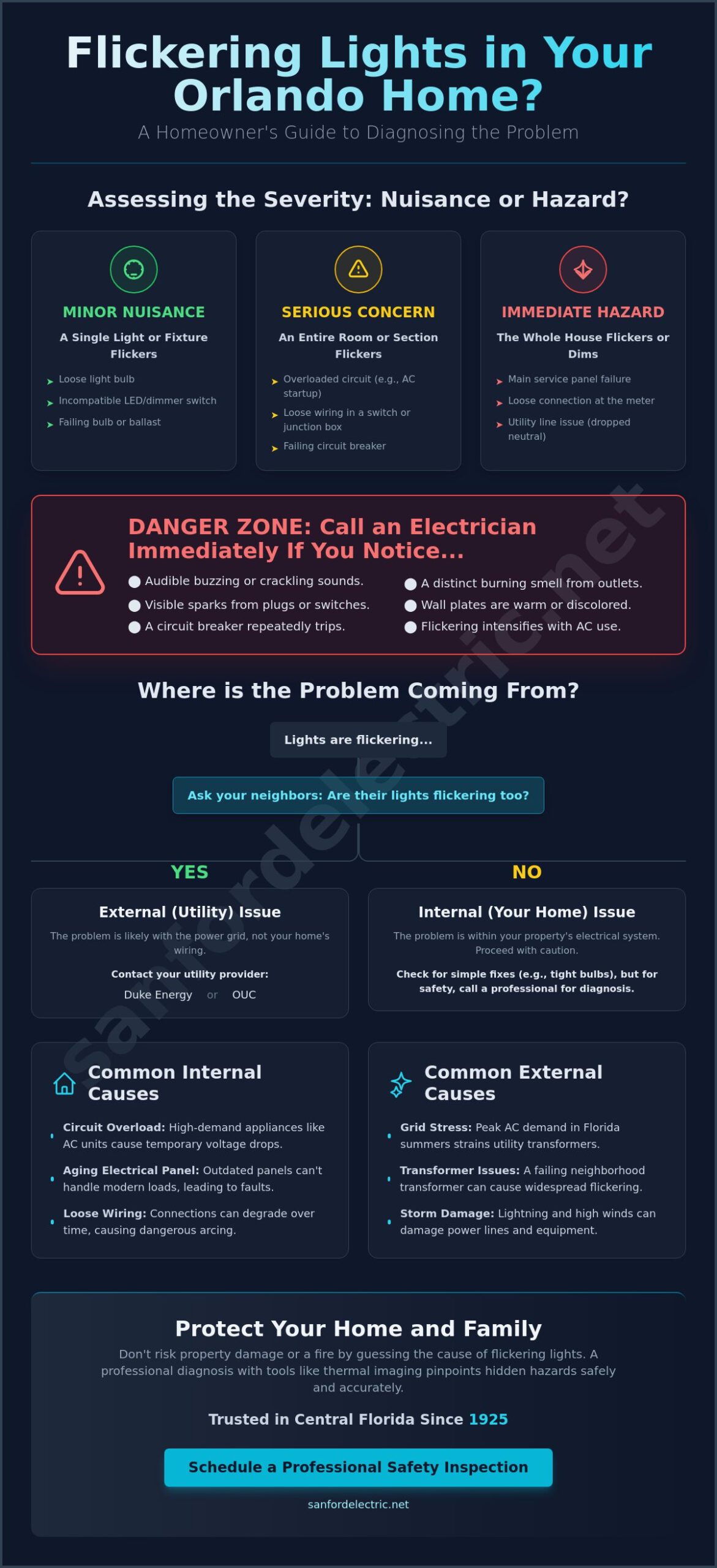
We define the “Danger Zone” as any instance where flickering is accompanied by audible buzzing or a distinct burning smell. These symptoms indicate that electrical current is escaping its intended path. In our 99 years of experience, we’ve observed that ignoring these signs can lead to significant equipment failure or structural damage. Safety is our priority, and we approach every diagnostic call with the technical precision required to stabilize your home’s power supply.
Is it a Nuisance or a Hazard?
Determining the scope of the problem is the first step in our process. A single fixture flickering usually indicates a loose bulb or a failing ballast. It’s a nuisance, but rarely an emergency. Room-wide flickering is more serious. This pattern often points to a circuit overload or a loose neutral wire within a junction box. If you experience whole-house flickering, the issue likely resides in your main service panel or the utility line. These systemic failures can damage modern 2026 appliances and require immediate professional intervention to ensure your system meets current safety standards.
When to Call an Emergency Electrician
Arcing represents one of the most significant risks to Central Florida homes. It occurs when electricity jumps across gaps in loose or damaged wiring, generating temperatures that can exceed 10,000 degrees Fahrenheit. If your lights flicker and your circuit breaker won’t stay reset, it’s a clear sign of a critical fault. You should contact a professional immediately if you notice:
- Visible sparks when plugging in devices.
- Wall plates that feel warm or show discoloration.
- Flickering that intensifies when the air conditioning compressor cycles on.
Sanford Electric Co. II, Inc. provides the reliable, 24/7 support that Orlando residents have trusted for nearly a century. We understand that electrical stability provides peace of mind. Our technicians use the same disciplined approach today that has defined our family-owned business since its founding, ensuring your home remains protected against the unique electrical challenges of the Florida climate.
Common External Causes: Is the Problem with Duke Energy or OUC?
Before you assume your indoor wiring is failing, you must determine if the source of the trouble originates from the utility grid. In Orlando, residential power is primarily managed by Duke Energy or the Orlando Utilities Commission (OUC). These providers maintain the infrastructure that delivers electricity to your meter, but Central Florida’s unique environment often stresses these systems. If you notice flickering lights in house Orlando properties, the culprit might be a failing neighborhood transformer or a loose connection at the utility pole. Transformer failures often occur during peak demand periods, leading to localized voltage drops that cause lights to dim or pulse throughout the entire street.
You can verify a grid issue by checking with your neighbors or visiting the OUC or Duke Energy online outage maps. If the flickering is isolated to your home, the problem likely exists between the utility pole and your main electrical panel. Since 1925, our team has helped homeowners distinguish between municipal grid failures and private property hazards. If you observe electrical fire safety warning signs such as a burning smell or sparks accompanying the flickering, disconnect power immediately and seek professional assistance.
Utility Grid Stress in Central Florida
Orlando experiences an average of 105 days per year where temperatures exceed 90 degrees. This extreme heat drives a massive surge in air conditioning demand, which places immense stress on the local electrical grid. During these heatwaves, voltage fluctuations are common as transformers struggle to keep pace with the load. A more serious external issue is a “dropped neutral” from the utility line. This occurs when the neutral wire connecting your house to the pole breaks or becomes loose. It causes unpredictable voltage swings that can destroy sensitive electronics. To report these issues, contact Duke Energy at 800-228-8485 or OUC at 407-423-9018 to request a line inspection.
Environmental Factors: Humidity and Corrosion
Orlando’s climate presents specific challenges for electrical stability. With an average annual rainfall of 52 inches and humidity levels frequently hovering near 90 percent, outdoor electrical components are prone to rapid oxidation. Corrosion on the lugs inside your outdoor meter socket creates high resistance, which manifests as flickering lights. Central Florida is also the lightning capital of the United States. A nearby strike can damage the surge protection in your home or weaken the insulation of underground service laterals. This environmental wear is why we prioritize durable, high-quality components in every repair. If your lights continue to pulse after a storm, you may need a professional inspection to ensure your system remains stable and safe for your family.
Internal Electrical Issues: Overloads and Aging Panels
When you notice flickering lights in house Orlando, the cause often sits directly inside your own walls. Our team has served Central Florida since 1925, and we’ve seen how modern technology taxes systems designed for a different era. While a brief flicker might seem like a minor annoyance, it often signals that your electrical infrastructure is struggling to keep up with daily demand. Identifying Common signs of an electrical problem early can prevent small issues from becoming expensive hazards. Scheduling a professional electrical safety inspection orlando provides a clear diagnostic of these hidden hazards and ensures your family’s peace of mind.
Circuit Overload and Large Appliances
In the Florida heat, your air conditioning compressor is the hardest working component in your home. You might notice your lights dim momentarily when the AC kicks on. This happens because the motor requires a massive “inrush” of current to start. A one-second dim is common, but persistent flickering indicates the circuit is overloaded. High-draw equipment like pool pumps, electric clothes dryers, and refrigerators should ideally run on dedicated circuits. If these appliances share a line with your lighting, the voltage drop will cause visible fluctuations. We recommend installing dedicated lines to protect sensitive electronics from these repetitive power dips.
The Risk of Aluminum Wiring and Aging Panels
Many homes built in Central Florida during the 1960s and 1970s utilized aluminum wiring. Over time, aluminum expands and contracts more than copper, which leads to loose connections at outlets and breakers. These loose points create heat and cause the flickering lights in house Orlando residents often report. Furthermore, older electrical panels were never designed to handle the “smart home” loads of 2026, such as EV chargers, high-speed servers, and multiple streaming devices.
The main breaker acts as the gatekeeper for your home’s power stability. If this component or the bus bars behind it are corroded or worn, you’ll experience whole-house flickering. Because these panels have a finite lifespan, an electrical panel upgrade orlando is often the most reliable way to restore stability. Modern panels provide the capacity needed for today’s high-tech lifestyle while significantly reducing fire risks. Our family-owned business has spent a century ensuring that Orlando homeowners don’t have to worry about the reliability of their power. We focus on steady, methodical repairs that address the root cause of the flicker rather than just masking the symptoms.
DIY Troubleshooting: What to Check Before Calling a Pro
Before requesting a professional service call, homeowners can often identify the source of flickering lights in house Orlando through a few safe, methodical checks. Since our founding in 1925, we’ve found that approximately 20 percent of residential lighting issues stem from simple component mismatches rather than deep wiring failures. Following a logical sequence helps you determine if the fix is a five-minute bulb swap or a project requiring a licensed technician.
- Step 1: Verify the bulb type. Check if you’re using LED, incandescent, or CFL bulbs. Each reacts differently to voltage fluctuations. Modern LEDs are particularly sensitive to minor electrical “noise” that older bulbs might ignore.
- Step 2: Check the seating. Ensure the bulb is screwed firmly into the socket. A loose connection creates a small gap where electricity jumps, or arcs, across the contact point. This causes the light to stutter.
- Step 3: Rule out the fixture. If a lamp is flickering, plug it into a different outlet on a separate circuit. If the flicker follows the lamp, the fixture’s internal wiring or the bulb is the culprit. If the flicker stops, the original outlet or circuit needs inspection.
- Step 4: Analyze the flicker pattern. Rhythmic, steady pulsing usually indicates a failing electronic driver inside an LED bulb. Random, erratic flickering is more concerning, as it often suggests a loose physical connection in a switch or junction box.
Bulb and Dimmer Compatibility
Many Central Florida homes built before 2010 utilize traditional leading-edge dimmers. These were designed for high-wattage incandescent loads. When you install a 9-watt LED on a dimmer expecting a 60-watt minimum load, the light will likely pulse or strobe because the circuit doesn’t draw enough current to keep the dimmer’s internal switch closed. If your flickering lights in house Orlando only occur when the dimmer is set below 50 percent, the hardware is likely mismatched. A failing LED driver will often flicker even at full power, which is a clear sign the bulb has reached its end of life.
Checking Your Breaker Box Safely
You can perform a visual inspection of your electrical panel without ever touching a wire. Open the door and look for any breaker switches that aren’t fully in the “on” position. A breaker that sits in the middle indicates a trip. If you notice a breaker feels warm to the touch, it’s a sign of an active overload or a failing component that requires professional diagnostic tools. A bus bar is a solid metal strip that distributes high-current power from the main service lines to the individual circuit breakers. If you see any signs of soot or “pitting” on the bus bar, shut off the main power immediately.
If these troubleshooting steps don’t resolve the issue, trust our century of experience to restore your home’s electrical integrity. Contact Sanford Electric Co. II, Inc. for a professional safety inspection and dependable repair.
Why Professional Diagnostics Save Orlando Homeowners Money
Addressing flickering lights in house Orlando requires more than just tightening a bulb. It demands a systematic approach to identify the root cause. Professional diagnostics save homeowners money by preventing the total loss of expensive appliances and avoiding the high costs associated with electrical fires. We utilize thermal imaging cameras to see what the naked eye cannot. These tools detect heat signatures behind drywall, pinpointing loose lugs or failing breakers before they reach the critical temperatures where wire insulation begins to degrade. This proactive technology stops electrical faults at the source, preserving your home’s value and structural integrity.
The cost of a diagnostic visit is a small fraction of the 1,400 dollar average deductible for many fire-related insurance claims. By identifying “hot spots” early, our technicians can perform targeted repairs. This prevents the need for full-scale rewiring projects that often follow a catastrophic failure. Our goal is to provide a clear, technical assessment that prioritizes your safety while respecting your budget.
Advanced Diagnostic Tools
Our technicians employ digital voltmeters to track “dirty power” coming from the utility grid or internal surges. Unstable voltage can reduce the lifespan of an expensive HVAC unit or modern smart refrigerator by as much as 50 percent. To prevent future issues, we torque all panel connections to specific inch-pound requirements set by manufacturers. This precision eliminates the vibration and heat cycles that cause wires to back out over time. A healthy electrical system also serves as the necessary baseline for generator installation central florida. We ensure your infrastructure can handle the demands of backup power before the next storm season arrives.
Using these tools allows us to distinguish between a simple fixture failure and a dangerous loose neutral wire. While a DIY approach might solve the flicker temporarily, it won’t address the underlying surge that could be damaging every electronic device in your home. We provide a documented report of our findings so you know exactly what’s happening with your power.
Trusted Service Since 1925
Sanford Electric Co. II, Inc. remains a pillar of the Central Florida community. Since 1925, we’ve maintained a standard of excellence that only a century of experience can provide. Four generations of our family have worked in the crawlspaces and attics of Orlando, Sanford, and Lake Mary. We understand the unique challenges of Florida’s humidity and its impact on electrical components over several decades. This historical perspective allows us to troubleshoot complex issues in older homes that newer companies might misdiagnose.
Our status as a licensed and insured, family-owned institution means we stand behind every wire we touch. We don’t use high-pressure sales tactics or unnecessary jargon. We provide functional solutions rooted in safety and stability. If you’ve noticed flickering lights in house Orlando, don’t wait for the problem to escalate. Contact us today to schedule a comprehensive safety inspection. Let our family protect yours with the dependable service we’ve provided for 100 years.
Secure Your Home’s Electrical Safety
Identifying the source of flickering lights in house Orlando is the first step toward maintaining a safe, functional living environment. Whether the issue stems from external utility fluctuations or internal components like a 20 year old breaker panel, professional intervention ensures your system meets 2026 safety standards. Our master electricians help you navigate these complexities by pinpointing hidden faults that standard DIY checks often miss. Professional diagnostics prevent minor flickers from turning into costly emergency repairs.
Sanford Electric Co II has provided quality service to the Central Florida community since 1925. We remain a family-owned and operated institution, now spanning four generations of technical expertise. Every technician on our team is a licensed and insured master electrician dedicated to the high standards we established nearly a century ago. You deserve the peace of mind that comes from a stable, professionally maintained electrical system that protects your family and your property.
We look forward to keeping your lights steady and your home secure.
Frequently Asked Questions
Is it normal for lights to flicker when the AC turns on in Orlando?
A brief flicker lasting less than one second is common when your air conditioner starts because the compressor draws three to five times its normal running current. If the lights dim by more than 5% or stay dim, it usually indicates a failing capacitor or an undersized circuit. In Orlando’s 90-degree summer heat, HVAC systems work harder, making this a frequent issue for local homes built before 1990.
Can a bad light switch cause flickering throughout the whole house?
No, a single faulty light switch only affects the specific fixtures connected to that circuit. If you notice flickering lights in house Orlando across multiple rooms, the problem likely resides in your main service panel or the meter base. Corroded bus bars or loose main lugs are common culprits we’ve diagnosed and repaired in Central Florida since our founding in 1925.
How much does it cost to fix flickering lights in a house?
Repair costs depend on the root cause, but national data from HomeAdvisor shows homeowners typically spend between $161 and $523 for professional electrical repairs. A simple loose wire at a terminal might fall on the lower end of that scale. Replacing a full electrical panel, which is necessary in about 15% of aging homes, represents a more significant investment in your property’s safety.
Should I call Duke Energy or an electrician for flickering lights?
You should call a licensed electrician first to determine if the fault is on your side of the electrical meter. If the flickering persists across every circuit in the home, it may be a utility issue. Duke Energy reports that 20% of power fluctuations stem from their transformers or service drops. We help identify if the problem belongs to the utility or your home’s internal wiring.
Can flickering lights cause an electrical fire?
Yes, flickering is often a symptom of arcing, which generates heat exceeding 1,000 degrees Fahrenheit. The National Fire Protection Association attributes 13% of home fires to electrical distribution or lighting equipment issues. Addressing these signs immediately ensures your family’s safety and protects your property from preventable combustion. Don’t ignore these warnings; they’re often the only signal of a dangerous connection.
Why do my LED lights flicker even when they’re turned off?
This happens because of ghost voltages or incompatible dimmer switches that allow a tiny amount of current to leak. LED bulbs require very little energy, so even 2 or 3 volts of residual current can cause them to glow or pulse. Replacing an old incandescent dimmer with a CL-rated model designed for LEDs resolves this issue in 95% of the cases we see.
What happens if a loose neutral wire is ignored?
An ignored loose neutral wire can cause a total system failure or destroy sensitive electronics by creating an unbalanced load. This condition can send 240 volts through a 120-volt circuit, which instantly fries appliances and computers. It’s a serious safety hazard that requires immediate attention from a professional technician to prevent permanent damage to your home’s electrical infrastructure.
Does Orlando’s humidity affect my home’s electrical wiring?
Yes, Orlando’s average humidity of 74% accelerates the corrosion of copper and aluminum connections over time. Moisture leads to oxidation, which increases electrical resistance and causes flickering lights in house Orlando. Since 1925, we’ve observed that homes in high-moisture areas require more frequent inspections to maintain stable connections. Regular maintenance helps prevent the decay that leads to flickering and power loss.