

What if your new master suite or sunroom becomes the reason your entire house goes dark? It’s a question many Central Florida homeowners forget to ask until the drywall is up and the breakers start tripping. At Sanford Electric, LLC, we’ve seen how guesswork leads to expensive setbacks and safety risks. Performing a precise electrical load calculation for home addition is the only way to ensure your existing system can handle the extra demand. Since 1925, our family has focused on providing the stability and peace of mind you need when expanding your living space.
You’re likely feeling a mix of excitement for your new space and anxiety over potential code violations or hidden costs. We understand that technical jargon like demand factors can feel overwhelming. This guide simplifies the planning process by explaining how the 2026 National Electrical Code (NEC) updates, such as the new standards for lighting loads, affect your project. You’ll learn how to evaluate your home’s capacity so you can pass local building inspections and enjoy a safe, well-lit addition without the frustration of flickering lights.
Key Takeaways
- Understand why a professional electrical load calculation for home addition is a legal requirement under the 2026 NEC to ensure your expansion is both safe and compliant.
- Recognize the physical warning signs of an overloaded system, such as flickering lights or zapping sounds, before they lead to permanent damage or safety hazards.
- Learn how the Volt-Amps per square foot rule and small appliance branch circuit requirements are used to accurately measure your home’s total power demand.
- Evaluate the differences between 100-amp, 200-amp, and 400-amp services to determine which capacity best supports your modern appliances and lifestyle.
- Discover the importance of professional permitting and expert load analysis to secure the long-term stability of your Central Florida property.
What is an Electrical Load Calculation for a Home Addition?
An electrical load calculation for home addition is a precise mathematical evaluation of your property’s total power requirements. It accounts for every light fixture, receptacle, and appliance currently in your home, plus everything planned for the new square footage. This process follows established North American electrical wiring standards to ensure the system operates within safe thermal limits. The National Electrical Code (NEC) mandates these calculations for structural expansions because adding even one room can push an older system past its breaking point.
Professionals distinguish between “connected load” and “demand load.” Your connected load is the sum of every electrical device in the house running simultaneously. Since you rarely run the dryer, the oven, and the pool pump at the exact same moment, we apply “demand factors” to find your demand load. This reflects actual usage patterns. A proper electrical load calculation for home addition prevents nuisance tripping, which is the frustrating cycle of breakers popping during normal activities. It also protects your sensitive electronics from premature failure caused by voltage drops. When your system is strained, it can’t provide the steady flow of power your high-end appliances require.
Why Guesswork is Dangerous for Your Expansion
Relying on a “gut feeling” about your home’s capacity is a recipe for disaster. Simply tapping into the nearest existing circuit to power a new bedroom often leads to overloaded wires. Overloaded circuits generate excessive heat, which can degrade insulation over time and create a fire hazard. Local building departments in Central Florida are well aware of these risks. They require a documented calculation before they’ll issue a permit. This documentation proves to inspectors that your project won’t compromise the safety of the neighborhood grid or your family’s well-being.
The Role of the Main Service Panel
Your main service panel acts as the distribution hub for your entire property. It has a finite capacity, usually measured in amps. When we plan an addition, the total square footage of the new space dictates a minimum lighting load. We also have to account for “headroom.” This is the spare capacity left over after your existing heavy hitters, like the air conditioner and water heater, are factored in. If your current panel is already near its limit, adding a new suite will likely require a professional panel upgrade to maintain stability. Since 1925, Sanford Electric, LLC has helped homeowners navigate these technical requirements with precision. We ensure your home’s central nervous system is ready for the future.
Signs Your Current Panel Can’t Handle the Expansion
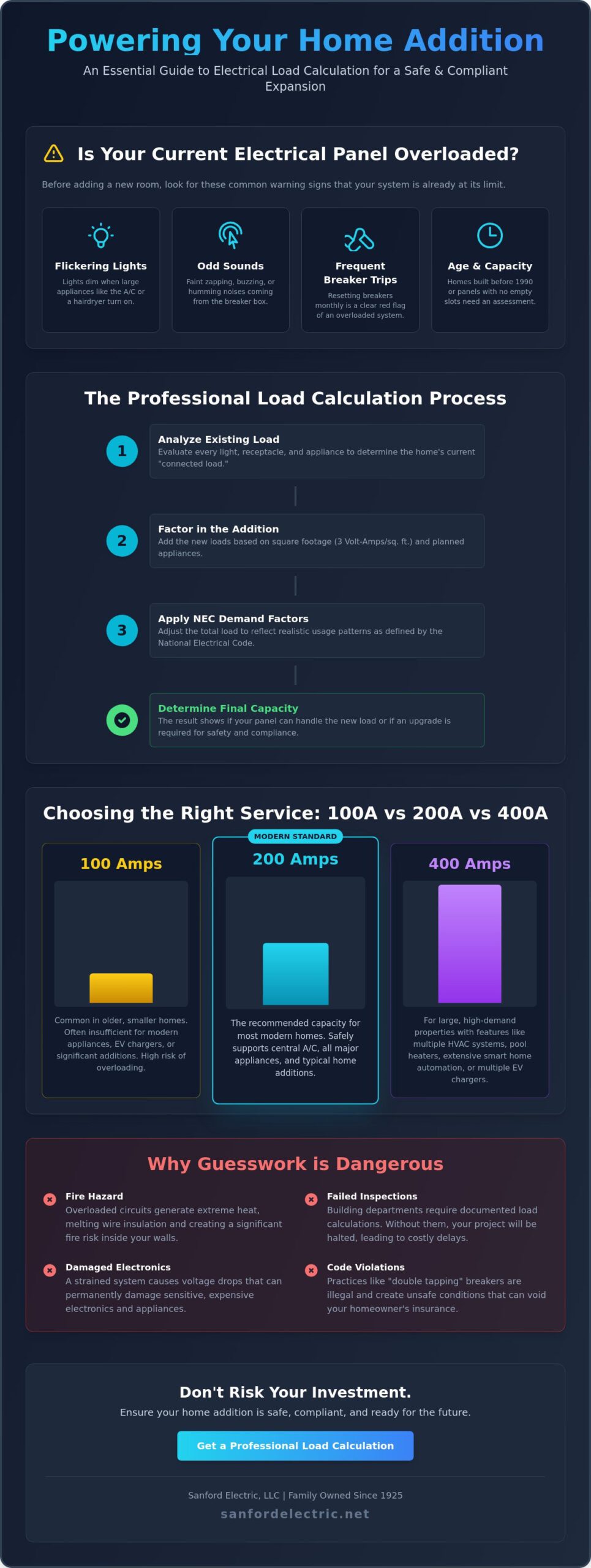
Your electrical panel is the heart of your home’s infrastructure. If it’s already struggling to power your daily life, adding new square footage will only amplify the problem. One common symptom is lights that flicker or dim momentarily when the air conditioner or a hair dryer starts up. This indicates that the initial inrush of current is starving other circuits, a clear sign that your system is operating at the edge of its capacity. You might also hear faint zapping or buzzing sounds from the breaker box, or see visible corrosion on the metal components. These are not just inconveniences; they are safety warnings that require attention before you begin an electrical load calculation for home addition.
The age of your property is a reliable indicator of potential issues. Houses built before 1990 typically weren’t designed for the high-draw electronics we use today. If your panel is already full of breakers with no empty slots for new circuits, your expansion plans are at a standstill. Frequent breaker trips are another red flag. If you are resetting breakers once a month now, the increased demand from a new room will likely make your electrical system unusable. Since 1925, we’ve helped Central Florida residents identify these warning signs to prevent costly power failures during construction.
Identifying Capacity Bottlenecks
Start by checking the main breaker at the top of your panel. Many older homes are limited to 100-amp or 150-amp service. While this was sufficient decades ago, modern lifestyle demands usually require a 200-amp service. We often see “Double Tapping” in crowded panels, where two wires are shoved into a single terminal meant for only one. This is a significant fire hazard and a code violation. Scheduling a professional electrical safety inspection in Orlando is the most reliable way to identify these hidden bottlenecks before you finalize your blueprints.
Future Demands: EV Chargers and Smart Tech
An electrical load calculation for home addition must look beyond your immediate needs. If you plan to install an EV charger or a high-end smart home hub in the next few years, you need to account for that demand now. We recommend leaving roughly 20% extra capacity in your panel to allow for future growth. This “headroom” prevents the need for a second, more expensive upgrade down the road. Our family-owned business prides itself on this kind of forward-thinking planning. If you’re concerned about your current capacity, a professional panel evaluation can provide the peace of mind you need to move forward with your project.
The NEC Framework: How Professional Load Calculations Are Performed
A professional electrical load calculation for home addition is far more complex than simply adding up the wattage of your new devices. We follow a structured framework defined by the National Electrical Code (NEC) to determine your home’s “calculated demand load.” This is a critical distinction that many DIY guides miss. Your total connected load is the sum of every light and appliance if they were all on at once. However, since you don’t use every outlet simultaneously, the NEC allows us to apply demand factors. These percentages reduce the total based on realistic usage patterns, ensuring your system is robust without being unnecessarily oversized.
One of the foundational steps involves the square footage rule. For the 2026 NEC, the general lighting load for dwelling units is calculated at 2 volt-amperes (VA) per square foot. This is a reduction from the previous 3 VA standard, reflecting the widespread adoption of energy-efficient LED lighting. We then add dedicated circuits for “Small Appliance Branch Circuits.” These are the 20-amp circuits required for kitchen and laundry areas. Even if your addition is just a bedroom, we must verify that these existing high-demand areas aren’t already straining the main service. Since 1925, our family has used these precise methods to provide stable power to Central Florida properties.
Safety also hinges on the 80% Rule. This rule dictates that any continuous load, which is anything running for three hours or more, must not exceed 80% of the circuit’s ampacity. This buffer prevents the thermal buildup that leads to fire hazards. We also perform specific calculations for “Fixed Appliances.” This category includes your dishwasher, water heater, and pool pumps. Each has a specific VA rating that must be accounted for before we can determine if your current panel has the capacity for your expansion.
The Standard vs. Optional Calculation Method
The NEC provides two distinct ways to perform an electrical load calculation for home addition. The Standard Method is a conservative, highly detailed breakdown often used for complex multi-family units or commercial projects. The Optional Method is a simplified calculation permitted for most single-family dwellings. It uses a tiered system, taking 100% of the first 10kVA of load and 40% of the remainder. For most residential projects in Central Florida, the Optional Method is the most efficient path to passing inspection while ensuring long-term reliability.
Accounting for Heavy Hitters: HVAC and Kitchens
Certain equipment demands special attention in our climate. HVAC systems are always calculated at 100% of their nameplate rating because they run almost continuously during Florida summers. Modern kitchens with double ovens or high-induction ranges also require significant capacity. Furthermore, if your project involves pool and hot tub wiring, these must be factored in as dedicated high-draw loads. We balance these heavy hitters across your phases to prevent one side of your panel from running hotter than the other, a level of detail that defines professional service.
Choosing the Right Service: 100A vs. 200A vs. 400A
Once the mathematical work is finished, the results of your electrical load calculation for home addition will dictate which service size your property requires. Electrical service is measured in amps, and choosing the wrong size can lead to frequent outages or the need for a second, more expensive upgrade later. A 100-amp service is generally reserved for very small cottages or simple room additions that don’t include heavy appliances. In 2026, this capacity is often insufficient for modern living standards. Most Central Florida homes larger than 1,800 square feet require at least a 200-amp service to handle central air conditioning, kitchen appliances, and laundry equipment safely.
For luxury estates or large-scale additions involving high-demand equipment, a 400-amp service provides the necessary stability. This is particularly common when adding guest houses or professional-grade home theaters. Sometimes, your main service has enough total power, but you’ve run out of physical space for new breakers. In these cases, a “subpanel” is a viable alternative. It acts as a satellite distribution point for the new addition without requiring a full service upgrade. Since 1925, our technicians have helped homeowners determine if a subpanel or a full upgrade is the most reliable path forward.
When an Upgrade is Non-Negotiable
Certain features make a service increase mandatory. If your new space includes a kitchen with a dedicated range, a bathroom with a high-draw water heater, or its own HVAC zone, your current system will likely be pushed past its thermal limits. Adding a “mother-in-law” suite essentially creates a second household’s worth of demand on one meter. Choosing an electrical panel upgrade in Orlando during the construction phase is often the most cost-effective decision. It ensures your new investment is protected by a system designed for 21st-century loads.
Future-Proofing Your Investment
Smart planning involves looking five to ten years into the future. Even if your current electrical load calculation for home addition suggests you can barely scrape by with your existing panel, upgrading now adds significant resale value to your property. Central Florida buyers increasingly look for homes ready for modern technology. This includes having the capacity for a high-speed EV charger installation in Orlando. By sizing your panel for future growth today, you avoid the disruption and expense of a second upgrade down the road. If you are unsure about your home’s current capacity, contact Sanford Electric Co. II, Inc. for a professional system analysis.
Ensuring Safety and Compliance with Sanford Electric, LLC
Since 1925, Sanford Electric, LLC has served as a pillar of the Central Florida community. We understand that a home expansion is a significant investment. Our team provides the technical expertise required to ensure your new space is powered by a system that is both safe and dependable. A professional electrical load calculation for home addition is the cornerstone of our process. We don’t just provide a number; we provide a comprehensive analysis that serves as a roadmap for your entire project. Our technicians work directly with your general contractor to coordinate every phase of the installation, from the initial rough-in to the final inspection. This collaborative approach prevents the communication gaps that often lead to construction delays or failed inspections.
As a family-owned and operated business, we treat every project with a level of personal accountability that larger corporations cannot match. We’ve spent over a century solving complex electrical challenges across Central Florida. This historical perspective allows us to anticipate issues before they arise, giving you the peace of mind that comes from hiring a seasoned expert. We prioritize safety and longevity, focusing on installations that will serve your family for decades to come. We don’t believe in shortcuts; we believe in doing the job right the first time.
Navigating Central Florida Building Permits
Local municipalities like Sanford, Orlando, and Lake Mary have strict requirements for structural expansions. These building departments require signed documentation showing a precise electrical load calculation for home addition before they will grant a permit. We have deep experience with local code enforcement and understand the specific nuances each city requires. We handle the technical paperwork and submission process on your behalf. This ensures your project moves through the approval phase efficiently, allowing you to focus on the design and enjoyment of your new space rather than administrative hurdles.
The Sanford Standard of Workmanship
Our licensed and insured technicians are trained to uphold the high standards we’ve maintained since our founding. We treat your property with the same care we would give our own homes. We avoid quick fixes that sacrifice safety for speed. Instead, we use quality materials and proven techniques to ensure your electrical system remains stable and efficient. Our “Quality Service Since 1925” tagline is more than a slogan; it’s a commitment to every client we serve. If you’re ready to start your expansion project, Contact Sanford Electric, LLC today for a professional load evaluation and ensure your home is ready for its next chapter.
Secure the Future of Your Central Florida Home Expansion
Adding new square footage to your property is an exciting milestone that requires a stable infrastructure. We’ve discussed how a precise electrical load calculation for home addition eliminates the risks of circuit overloads while ensuring your project complies with the updated 2026 NEC standards. By identifying current panel bottlenecks and planning for future high-demand technology like EV chargers, you protect your investment and your family’s safety. Moving forward with data rather than guesswork is the only way to ensure your new space remains functional and code-compliant for years to come.
Sanford Electric Co. II, Inc. has served as a reliable local authority in Central Florida since 1925. Our family-owned business brings four generations of expertise to your project, handling everything from technical load analysis to local permitting with disciplined care. We prioritize long-term stability and safety over quick fixes. Our technicians understand the specific requirements of our community and the rigorous standards of the National Electrical Code. Schedule your professional load calculation with Sanford Electric Co II today! We are ready to help you ensure your home expansion is a safe and successful reality.
Frequently Asked Questions
Do I really need a load calculation for a small room addition?
Yes, any structural expansion requires an electrical load calculation for home addition to comply with the National Electrical Code. Even a small bedroom adds new lighting and receptacle loads that can strain an older system. We perform these assessments to ensure your new space operates within safe thermal limits and meets all local Central Florida building standards.
How long does a professional electrical load calculation take?
A professional on-site evaluation typically takes between one and two hours to complete. During this visit, our technicians catalog your existing heavy appliances and inspect your current panel’s condition. We then finalize the mathematical documentation in our office to ensure every demand factor is accurately reflected for your building permit submission.
Can I perform an electrical load calculation myself using an online tool?
While online tools exist, they often miss the nuanced demand factors and specific 2026 NEC updates required for a legal permit. These tools don’t account for the physical condition of your wiring or local permitting nuances in cities like Orlando. Professional analysis provides the documented certainty needed to pass inspections and ensure long-term safety.
What happens if I add an addition without upgrading my panel?
Adding an expansion to an undersized panel leads to frequent breaker trips and can cause your electrical system to overheat. This creates a significant fire hazard and can lead to the premature failure of expensive electronics. Since 1925, we’ve focused on helping homeowners avoid these costly mistakes by ensuring their infrastructure matches their lifestyle needs.
Will my local building department in Florida require a documented load calculation?
Yes, building departments in Sanford, Lake Mary, and throughout Central Florida require a signed electrical load calculation for home addition before issuing construction permits. This documentation is a critical part of the safety review process. Our team handles this technical paperwork to ensure your project stays on schedule and meets all local enforcement standards.
How much extra capacity should I leave in my panel for future upgrades?
We recommend leaving roughly 20% of your panel’s total capacity as “headroom” for future growth. This extra space allows you to install high-draw equipment like EV chargers or professional landscape lighting without another service upgrade. This forward-thinking approach has been a cornerstone of our family-owned business for four generations.
Does a home addition always require a 200-amp service upgrade?
Not every project requires a service increase, but 200 amps is the modern standard for most Central Florida homes with central air. If your current service is only 100 or 150 amps, an upgrade is often necessary to provide the stability required for modern appliances. We evaluate your specific usage patterns to determine the most cost-effective path forward.
Can a subpanel solve my capacity issues without a full service upgrade?
A subpanel adds more physical slots for breakers but it does not increase the total amount of power coming into your home. If your main service is already maxed out, a subpanel won’t prevent the main breaker from tripping. It’s a great tool for organizing new circuits if your primary service has enough available amperage.