
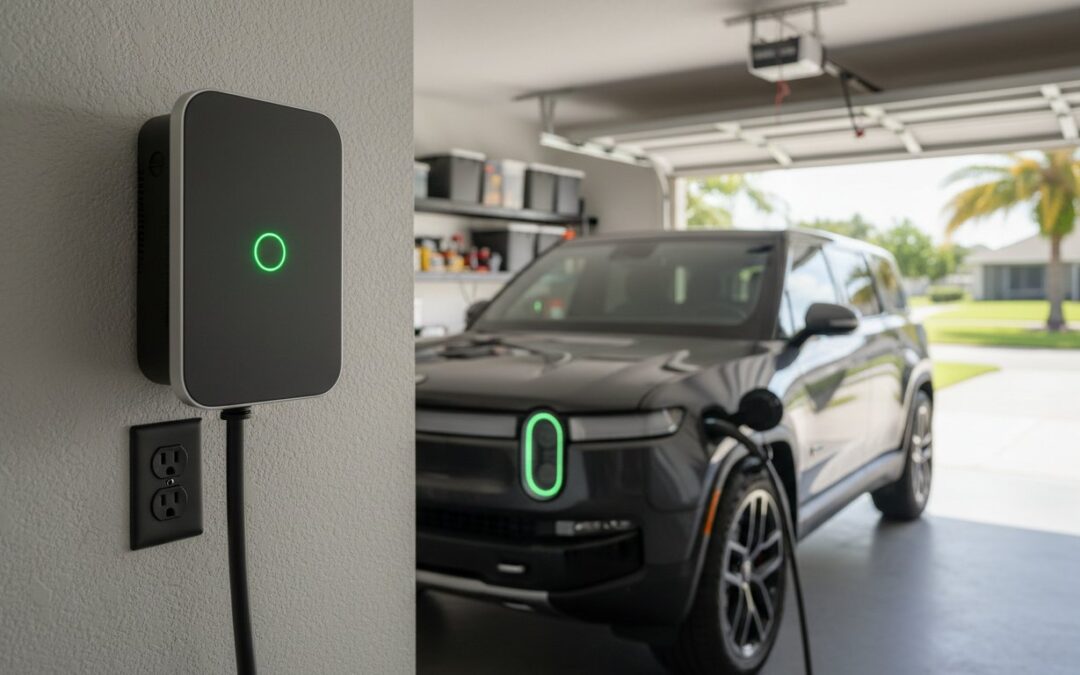
Last Tuesday, a homeowner in Sanford realized their standard wall outlet provided only three miles of range per hour, leaving them stranded before a morning commute to Orlando. You likely know that slow charging is more than an inconvenience; it’s a barrier to actually enjoying your electric vehicle. While you want the speed of a Level 2 setup, the confusion over differing quotes and the fear of electrical strain on an older Florida home can be paralyzing. At Sanford Electric Co. II, Inc., we’ve seen how these concerns affect our neighbors across Central Florida since 1925.
The total cost to install 240v outlet for EV charger depends on your home’s existing capacity and current 2026 material standards. We’ll help you understand the real-world factors that drive these prices, from copper wire fluctuations to specific municipal codes in Orange and Seminole counties. This guide provides a clear look at how to achieve a safe, code-compliant installation while taking advantage of local utility rebates that can lower your upfront investment. We’ll break down the technical requirements and labor variables so you can move forward with confidence and peace of mind.
Key Takeaways
- Learn how upgrading to Level 2 charging significantly reduces downtime by providing the reliable power required for modern EV ownership in Central Florida.
- Understand how labor, wire gauge, and electrical panel capacity influence the total cost to install 240v outlet for EV charger in your home.
- Compare the benefits of NEMA 14-50 outlets versus hardwired stations while ensuring your setup meets the latest 2026 NEC safety standards and GFCI requirements.
- Navigate local permitting in Sanford and Orlando and discover how to maximize your savings through 2026 Duke Energy and OUC rebate programs.
- Discover why safety and longevity are paramount and how our family-owned tradition of quality service since 1925 protects your home investment.
Understanding the Value of a 240V Outlet for EV Charging
A 240V outlet, commonly known as Level 2 charging, is a dedicated circuit that delivers the power needed to keep a modern electric vehicle ready for the road. Since 1925, Sanford Electric Co. II, Inc. has seen electrical standards evolve, and the shift toward high-voltage home charging is one of the most significant changes for Central Florida homeowners. While a standard 120V wall outlet might suffice for a small plug-in hybrid, it rarely meets the demands of a fully electric car.
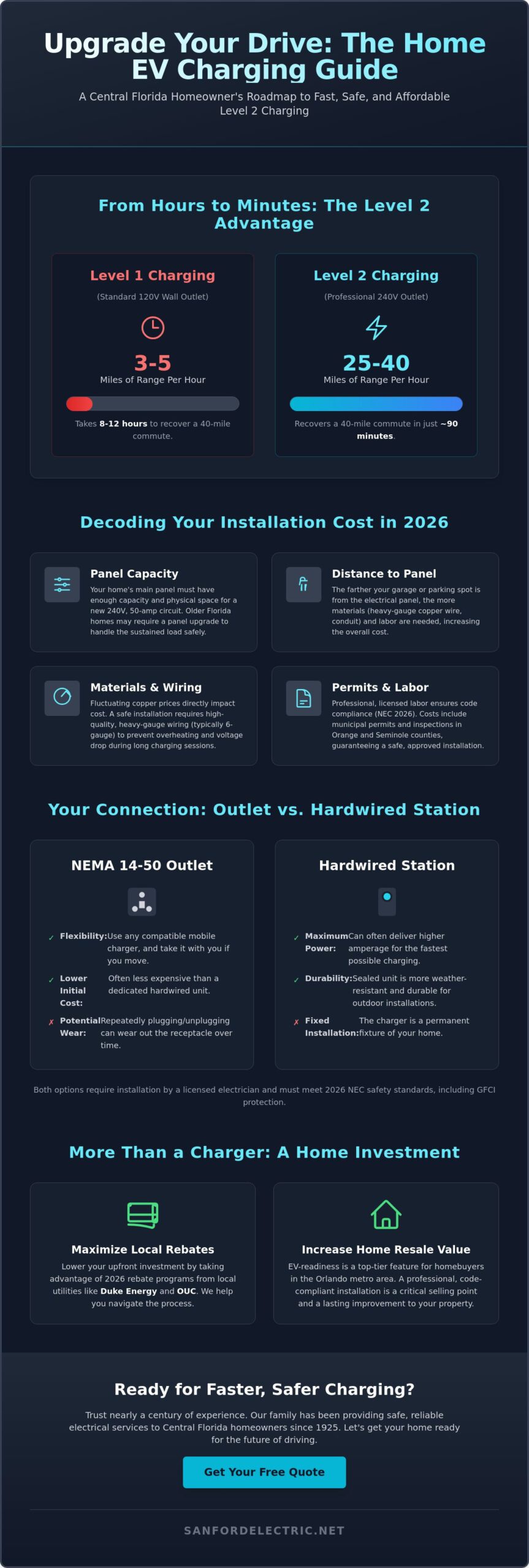
The primary difference lies in the delivery of energy. Standard 120V outlets provide roughly 3 to 5 miles of range per hour of charging. In contrast, a 240V outlet provides 25 to 40 miles of range per hour. For a Sanford resident commuting 40 miles round-trip to Orlando daily, a Level 1 charger takes 8 to 12 hours just to recover that single trip. A 240V setup finishes the job in about 90 minutes. This provides the “overnight full tank” experience that makes EV ownership practical. You plug in when you get home, and by the time you wake up, the vehicle is fully charged and ready for the heat and traffic of I-4.
Commuters traveling between Sanford, Lake Mary, and downtown Orlando often put 15,000 miles or more on their vehicles annually. This daily mileage requires a reliable charging solution that doesn’t leave you stranded or forced to wait at public electric vehicle charging stations during your evening hours. Our family-owned business understands that for local families, time is just as valuable as the electricity itself.
Level 1 vs. Level 2: The Time and Cost Equation
Level 1 charging often fails because it cannot keep pace with the 12.5 kilowatt-hours an average EV consumes during a typical 40-mile commute. In Central Florida, temperatures frequently exceed 90 degrees during the summer, which forces the vehicle’s thermal management system to work harder during the charging process. A 240V outlet is more efficient because it moves more energy in less time, reducing the duration the cooling system must run. Level 2 charging is the standard for home convenience.
Impact on Home Resale Value in Central Florida
As of 2024, EV readiness has become a top-tier feature for homebuyers in the Orlando metropolitan area. Installing a dedicated 240V circuit provides a long-term benefit for high-draw appliances beyond just vehicles, such as heavy-duty shop tools. When you evaluate the cost to install 240v outlet for EV charger, it’s vital to view it as a permanent home improvement. Professional installation ensures the work meets the National Electrical Code, which is a critical selling point during home inspections. Our technicians have provided this level of dependable service for nearly a century, ensuring your home remains modern, safe, and marketable.
Factors Influencing the Cost to Install a 240V Outlet in 2026
Calculating the cost to install 240v outlet for EV charger involves more than a simple flat fee. Your total investment depends on three primary variables: labor, materials, and the current capacity of your electrical panel. One of the most significant factors is the “distance to panel” rule. If your garage is on the opposite side of the house from your electrical service, the price increases. Longer runs require heavier wire gauges to prevent voltage drop, which adds to both material costs and the time required for routing conduit through walls or attics.
In 2026, copper prices and conduit availability continue to fluctuate, impacting every electrical quote in Central Florida. High-quality copper wiring is essential for a safe home EV charging installation because Level 2 chargers pull high amperage for several hours at a time. Before starting any work, we always perform an electrical safety inspection in Orlando to identify potential weak points in your existing system. This ensures your home can handle the sustained load without risking a fire or equipment failure.
The Hidden Costs of Older Florida Homes
Homes in older Sanford or Winter Park neighborhoods often present unique challenges. Many of these properties were built decades before high-draw appliances like EV chargers existed. If your home still uses a fuse box or an outdated Federal Pacific panel, adding a 50-amp circuit isn’t just difficult; it’s dangerous. These older components often fail to trip during an overload, which creates a significant fire hazard. In these cases, a professional electrical panel upgrade in Orlando is a necessary prerequisite to ensure your home meets 2026 safety standards.
Labor and Professional Expertise in Central Florida
While a handyman might offer a lower rate, licensed electricians are required for high-voltage EV work. The 2026 labor market shows a high demand for specialized EV technicians who understand the nuances of thermal management and local building codes. At Sanford Electric Co. II, Inc., we follow a strict standard of quality that has defined our family-owned business since 1925. Our technicians don’t just pull wire; they calculate load demands and install industrial-grade components designed to last. This level of expertise provides the peace of mind that your charger will operate reliably every night. If you’re unsure about your garage’s readiness, you can schedule a consultation with our team to review your options.
- Wire Gauge: Thicker wire is needed for runs exceeding 50 feet to maintain efficiency.
- Permitting: Local Sanford and Orlando municipal fees vary based on project scope.
- Panel Space: A dedicated double-pole breaker requires two open slots in your panel.
NEMA 14-50 Outlet vs. Hardwired EV Chargers: A Cost-Benefit Analysis
Choosing between a NEMA 14-50 outlet and a hardwired station is the primary decision our Central Florida clients face. While the cost to install 240v outlet for EV charger setups is often lower upfront, the 2023 and 2026 National Electrical Code (NEC) updates changed the financial landscape. These codes require GFCI (Ground Fault Circuit Interrupter) breakers for all 240V outlets installed in garages. A GFCI breaker typically adds $100 to $150 to the material costs compared to a standard breaker used for hardwired units. This narrow price gap makes hardwiring a competitive alternative for long term reliability.
Hardwired installations bypass the need for these expensive breakers because the charging station itself provides the necessary ground fault protection. For a detailed breakdown of local regulations and permitting, see our 2026 homeowner’s guide to EV charger installation in Orlando. This home EV charging guide from the EPA also provides a helpful framework for understanding these safety certifications and basic electrical requirements.
The NEMA 14-50 Standard: Pros and Cons
The NEMA 14-50 outlet is popular because it offers plug and play flexibility. Vehicles like the Tesla Model 3, Ford F-150 Lightning, and Chevrolet Bolt frequently utilize NEMA 14-50 mobile connectors for home use. However, the quality of the hardware is vital. We’ve seen consumer grade outlets from big box stores fail under the continuous heat of an 8 hour charge cycle. We always recommend industrial grade outlets to prevent terminal degradation. A professional NEMA 14-50 installation requires a dedicated 50-amp breaker and 6-gauge copper wiring to handle the load safely.
When Hardwiring is the Smarter Investment
Hardwiring is the superior choice for high performance charging. If you want to utilize 48-amp or 80-amp speeds for faster recovery times, a hardwired connection is mandatory. Hardwired systems are also more resilient in the humid environments of Florida garages. Without a plug and socket interface, there’s no risk of plug melt or corrosion at the contact points. Our family owned business has provided quality service since 1925, and we’ve found that hardwired units offer a cleaner aesthetic with significantly fewer failure points. This setup ensures your cost to install 240v outlet for EV charger translates into a permanent, high capacity solution that stands the test of time.
Navigating Local Permits and Rebates in Orlando, Sanford, and Lake Mary
Installing a dedicated circuit for your vehicle isn’t just about the hardware. It requires strict adherence to Central Florida building codes. Since 1925, Sanford Electric Co. II, Inc. has prioritized safety and professional integrity over shortcuts. When you evaluate the cost to install 240v outlet for EV charger, you must include permit fees in your budget. In cities like Sanford, Orlando, and Lake Mary, an electrical permit is a legal requirement for this type of high-voltage work. Skipping this step is a significant risk. Unpermitted electrical work can lead to home insurance claim denials if an electrical fire occurs. Most Florida homeowners’ policies specifically exclude coverage for losses caused by non-code-compliant installations.
Duke Energy and OUC EV Incentives
In 2026, local utility providers continue to offer financial support to homeowners transitioning to electric transport. The Orlando Utilities Commission (OUC) provides a $200 rebate for residential customers who install a Level 2 charging station. Duke Energy offers a specialized “Off-Peak” charging credit program. By scheduling your charging between 9:00 PM and 6:00 AM, you can earn a $10 monthly credit on your utility bill, resulting in $120 in annual savings. Additionally, the Federal Alternative Fuel Vehicle Refueling Property Credit allows you to claim 30% of the hardware and installation costs on your tax return, capped at $1,000. To secure these incentives, you must submit your official Sanford Electric invoice. These programs require proof that a licensed contractor performed the work.
The Permitting Process: Why It Protects You
A permit triggers a mandatory inspection by city officials in Apopka, Altamonte Springs, or Lake Mary. This third-party verification ensures the cost to install 240v outlet for EV charger includes a professional load calculation. Many older homes in Central Florida have electrical panels that are already near their maximum capacity. Our technicians verify if your 100-amp or 200-amp service can safely handle the additional 40 to 50 amps required by a Level 2 station. A “quick” unpermitted job often ignores these critical calculations, which can lead to tripped main breakers or overheated wiring behind your walls. Sanford Electric Co. II, Inc. manages the entire filing process for you. We ensure your home remains a safe environment while maintaining its long-term market value.
Don’t risk your home’s safety or insurance coverage with unpermitted work. Contact our team of experts to schedule a code-compliant installation today.
Choosing a Professional Electrician: The Sanford Electric Co. II Advantage
Selecting the right contractor involves more than comparing the initial cost to install 240v outlet for EV charger. It requires finding a partner who prioritizes your home’s safety and long-term electrical stability. Sanford Electric Co. II is a family-owned business with a legacy that began in 1925. For over a century, we’ve provided dependable electrical solutions across Central Florida. Our “Quality Service Since 1925” tagline represents a multi-generational commitment to excellence that modern startups cannot replicate.
Our comprehensive approach ensures your home handles the increased demand of a Level 2 charger without compromise. We perform precise load calculations to prevent panel overloads and potential fire hazards. We manage every step of the process, including securing necessary permits and coordinating the final city inspection. This thoroughness makes us the premier provider for EV charger installation in Central Florida.
Four Generations of Electrical Excellence
A century of experience allows us to bridge the gap between traditional craftsmanship and modern technology. While the tools have changed since 1925, our dedication to safety remains constant. We serve a wide radius from our home base in Sanford to the residential communities of Windermere. Every technician we send to your door is licensed, insured, and background-checked for your peace of mind. You’ll work with experts who understand the specific electrical codes of the Orlando area. This expertise ensures your cost to install 240v outlet for EV charger is a sound investment in your property’s value.
Ready to Upgrade Your Home? Get a Professional Quote
Electrical work carries inherent risks that require professional oversight. Cutting corners on a high-voltage installation can lead to equipment failure or expensive repairs later. By choosing a trusted local anchor, you ensure the job is done right the first time. We provide clear, honest assessments tailored to your home’s unique layout and power needs. Our team is ready to help you transition to electric driving with confidence and the reassurance that comes from 100 years of local service.
Don’t leave your home’s safety to chance. Contact Sanford Electric Co. II for your 240V outlet installation today to schedule your professional home assessment and receive a detailed, transparent quote.
Secure Your Home’s Electric Vehicle Infrastructure
Investing in a dedicated home charging station is a significant step toward energy independence. Understanding the cost to install 240v outlet for EV charger requires looking at your home’s current electrical load and local permitting requirements in 2026. Whether you opt for a NEMA 14-50 outlet or a hardwired solution, safety remains the top priority. Sanford Electric Co. II has served the Central Florida area since 1925, providing the professional expertise needed to navigate evolving electrical codes. Our family-owned business maintains strict adherence to NEC 2023 and 2026 standards, ensuring your installation is both legal and secure. We bring a century of technical proficiency to every job, from residential garages in Lake Mary to commercial fleets in Orlando. You don’t have to guess when it comes to high-voltage work. Rely on a licensed and insured team that’s supported this community for generations. We’re here to provide the peace of mind that comes with quality craftsmanship and proven results.
Schedule Your Professional EV Outlet Installation with Sanford Electric
We look forward to helping you power your journey with confidence and reliability.
Frequently Asked Questions
How much does it typically cost to install a 240V outlet for an EV in Orlando?
The national average cost to install 240v outlet for EV charger ranges from $300 to $800 according to 2024 data from Angi. In Orlando, your final price depends on the distance between your electrical panel and the garage. Our team provides precise quotes based on your home’s specific layout; ensuring you receive the same reliable service we’ve delivered since 1925.
Do I need a permit to install a 240V outlet in my garage in Sanford?
You must obtain an electrical permit to install a 240V outlet in Sanford. The City of Sanford Building Division enforces the 2023 Florida Building Code, which requires a permit for any new electrical circuit. This process ensures the installation meets safety standards. We handle the permitting paperwork for our Central Florida clients to ensure every job is fully compliant and documented.
Can my existing electrical panel handle a new 240V EV outlet?
Most modern 200-amp electrical panels can support a new 240V EV outlet, but older 100-amp panels often require an upgrade. A standard Level 2 charger pulls 32 to 40 amps continuously, which accounts for a large portion of a smaller panel’s capacity. Our technicians perform a load calculation to determine if your existing system can safely handle the additional demand without tripping main breakers.
The primary cost to install 240v outlet for EV charger increases if your 1970s-era panel lacks the physical space or electrical headroom for a new double-pole breaker. We’ve assessed thousands of Central Florida homes to ensure they’re ready for the transition to electric transit.
What is the difference between a NEMA 14-50 and a Tesla Wall Connector?
A NEMA 14-50 is a heavy-duty 240V plug that offers versatility, while a Tesla Wall Connector is a hardwired station that provides faster charging speeds. The NEMA 14-50 typically delivers 40 amps, whereas the Wall Connector can handle up to 48 amps on a 60-amp circuit. Choosing the right option depends on your daily mileage and whether you want a portable or permanent charging solution for your home.
Are there any tax credits or rebates for EV charger installation in Central Florida?
Residents in Central Florida can claim a federal tax credit of 30% for hardware and installation costs, up to $1,000, through the 30C tax credit extended through 2032. Additionally, local utilities like OUC have historically offered rebates for residential customers. We recommend checking the current 2026 incentive lists from Duke Energy to maximize your savings. Our family-owned business helps you identify these cost-saving opportunities during our visit.
How long does the installation of a 240V outlet usually take?
A standard installation of a 240V outlet usually takes between 2 and 4 hours to complete. If your electrical panel is located on the opposite side of the house from your garage, the process might take longer due to the complexity of the conduit run. Our experienced technicians work efficiently to minimize disruption to your schedule while maintaining the high safety standards we’ve upheld since 1925.
Can I install a 240V EV outlet myself to save money?
You shouldn’t attempt to install a 240V EV outlet yourself because the high voltage poses a significant risk of fire or electrocution. Professional installation ensures the wire gauge and breaker size match the 2023 National Electrical Code requirements. Hiring a licensed contractor protects your home’s value and ensures your vehicle’s warranty remains valid. We prioritize your family’s safety by sending seasoned experts to handle every installation.
What happens if I install an EV charger without a permit in Florida?
Installing an EV charger without a permit in Florida can lead to fines from local municipalities and may void your homeowner’s insurance policy. If an electrical fire occurs, insurance providers often deny claims for work performed without a valid permit and professional inspection. Since 1925, we’ve focused on protecting our neighbors by following every legal requirement. Proper documentation provides peace of mind and ensures your installation is recorded with the county.