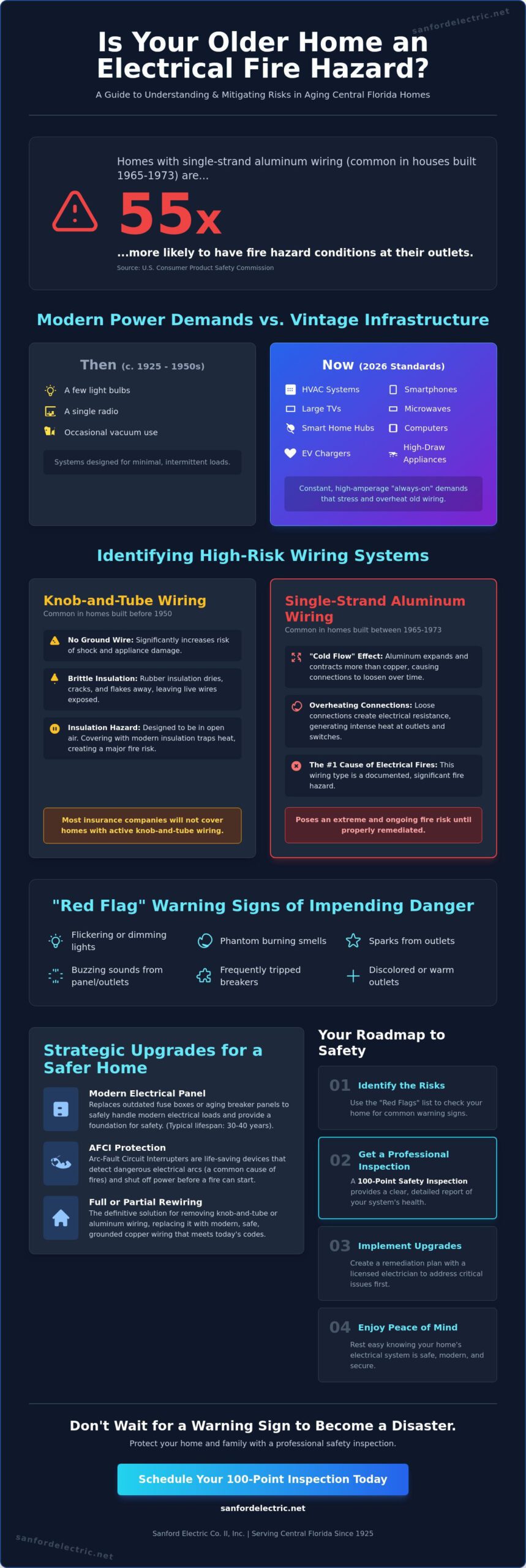
Did you know that homes built before 1972 with single strand aluminum wiring are 55 times more likely to have fire hazard conditions at their outlets? It’s a sobering statistic from the U.S. Consumer Product Safety Commission that many Central Florida homeowners face every day. When you live in a house with history, it’s natural to feel anxious about avoiding electrical fire hazards in old homes, especially when modern power demands clash with aging wires and outdated panels.
At Sanford Electric Co. II, Inc., we’ve been helping families find peace of mind since 1925. We understand the stress of balancing safety with the reality of aging infrastructure. This guide simplifies the process of identifying hidden risks and the professional steps required to fix them. You’ll get a clear checklist of warning signs, learn why certain legacy wiring is now an insurance liability, and see a roadmap for modernizing your electrical system to meet 2026 safety standards.
Key Takeaways
- Learn the essential steps for avoiding electrical fire hazards in old homes by understanding how modern power demands stress legacy systems.
- Identify the specific risks associated with knob-and-tube and aluminum wiring common in older Central Florida residences.
- Recognize critical “red flag” warning signs, such as flickering lights or phantom burning smells, before they escalate into an emergency.
- Discover why modernizing your electrical panel and adding AFCI protection provides a necessary safety foundation for aging infrastructure.
- Understand how a professional 100-point safety inspection provides a clear roadmap for long-term home remediation and peace of mind.
The Evolution of Home Electricity: Why Old Wiring Struggles in 2026
Sanford Electric Co. II, Inc. opened its doors in 1925. At that time, a typical Central Florida home used electricity for a handful of light bulbs and perhaps a single vacuum cleaner. Today, that same infrastructure is often expected to power high-efficiency HVAC systems, electric vehicle chargers, and a constant stream of smart devices. This massive leap in power consumption is the primary reason why avoiding electrical fire hazards in old homes is more critical now than ever before. Our technicians have seen the direct results of this strain while serving the community for over a century.
Many homeowners believe that if their lights turn on, their system is safe. This is a dangerous fallacy. Wiring that has “worked for decades” is often operating at its absolute thermal limit. In our local climate, the relentless Central Florida heat and humidity act as silent catalysts for decay. Moisture accelerates the corrosion of metal connections, while high temperatures in unconditioned attic spaces make vintage wire insulation brittle and prone to cracking. When insulation fails, the risk of an arc flash or a structural fire increases exponentially.
Modern Power Demands vs. Vintage Infrastructure
A vintage 1950s radio pulled a fraction of the amperage required by a modern microwave or a high-capacity refrigerator. When high-draw appliances pull current through thin, aged wiring, the friction of electrons creates heat. Over time, this heat degrades the surrounding materials. Modern electronics are also far more sensitive than their ancestors. Voltage fluctuations that a 1920s incandescent bulb would ignore can easily damage the delicate circuitry of a 2026 smart home hub or a high-end computer system. Older systems simply weren’t designed for the “always-on” nature of 21st-century life.
The Life Expectancy of Residential Electrical Components
Most residential electrical components have a defined service life. Early systems used Knob-and-tube configurations with rubber-based insulation. This rubber eventually dries out and flakes away, leaving bare wires exposed inside your walls. While modern plastic-insulated wiring is more durable, it’s still not permanent. A typical electrical panel is designed to remain in service for roughly 30 to 40 years. In Orlando, environmental factors like high humidity and seasonal storms can shorten the life of outdoor service entries and meter cans. Regular inspections are the only way to ensure these components haven’t reached their breaking point, helping you succeed in avoiding electrical fire hazards in old homes before they start.
Identifying High-Risk Wiring Systems: From Knob-and-Tube to Aluminum
Sanford Electric Co. II, Inc. began serving Central Florida in 1925, a time when knob-and-tube was the industry standard. While these systems were designed with the best materials of the era, they simply aren’t equipped for the power loads of 2026. Identifying these legacy systems is the first step in avoiding electrical fire hazards in old homes. If your residence was built before 1950 or during the copper shortages of the late 1960s, you likely have one of these high-risk configurations hidden behind your walls.
The Dangers of Knob-and-Tube and Lack of Grounding
Knob-and-tube wiring consists of single insulated copper conductors supported by porcelain knobs and protected by porcelain tubes where they pass through wood framing. The most significant safety flaw is the total lack of a grounding wire. Without a ground, excess electricity has no safe path to the earth during a surge or fault. This significantly increases the risk of both structural fires and dangerous electrical shocks to anyone using an appliance.
A common but dangerous mistake occurs during modern energy efficiency upgrades. Many homeowners add blown-in insulation to their attics to combat the Florida sun. When you cover knob-and-tube wiring with modern insulation, you trap the heat generated by the wires. These systems were engineered to dissipate heat into open air. When smothered, the wires can reach combustion temperatures, turning your attic insulation into a fire hazard. This is a primary reason why most insurance carriers now refuse to issue or renew policies for homes with active knob-and-tube systems.
Aluminum Wiring Risks in Central Florida Homes
If your home was built between 1965 and 1973, it likely contains single-strand aluminum wiring. Aluminum expands and contracts much more than copper when current flows through it. This “cold flow” phenomenon causes connections at outlets and switches to loosen over time. Loose connections create electrical resistance, which generates intense heat and leads to dangerous arcing. Recognizing the Red Flags of aluminum failure is vital for safety.
In our humid Central Florida environment, aluminum is also prone to oxidation. This creates a high-resistance layer that further increases heat at every connection point. While some homeowners opt for a full rewire, we also provide specialized aluminum wiring remediation. This process uses specific, approved connectors to secure the system without the need for a total teardown. Beyond the metal itself, look for deteriorated cloth insulation. Over the decades, this cloth becomes brittle and turns into a dry tinderbox. If you’re concerned about what’s behind your drywall, a professional electrical safety inspection can identify these hidden risks before they become emergencies.
Recognizing the Red Flags of an Impending Electrical Fire
In our experience at Sanford Electric Co. II, Inc., many homeowners don’t realize their house is communicating with them. Electrical “red flags” are specific sensory or performance cues that indicate a component is nearing failure. Ignoring these signals is the most common mistake made when avoiding electrical fire hazards in old homes. Because we’ve been troubleshooting Central Florida properties since 1925, we’ve learned that your senses are often the first line of defense against a catastrophic event. These signs are your home’s way of telling you that the vintage infrastructure is struggling under modern stress.
Sensory Warning Signs: Smell, Sound, and Touch
You should never ignore a “phantom” burning smell. If you detect a scent similar to ozone, burning plastic, or even a strange “fishy” odor near an outlet, it’s likely that the wire insulation is melting. This occurs when electricity arcs between loose connections, creating intense localized heat. You might also hear this happening. A buzzing, sizzling, or popping sound inside a wall isn’t just a nuisance; it’s the audible sign of an active electrical arc. This is the sound of electricity jumping a gap, which can easily ignite old wooden studs or dry insulation.
We recommend a safe “touch test” for your switch plates and outlets. Use the back of your hand to gently feel the cover plate. If it feels warm or hot to the touch, you have a loose connection or an overloaded circuit. Over time, this heat causes visual proof of danger. Look for brown or black discoloration on the face of the outlet or the surrounding wall. This charring means a fire has already started at a microscopic level. If you see these marks, stop using that outlet immediately and keep the circuit turned off until it can be professionally inspected.
Performance Issues: Flickering Lights and Tripped Breakers
Performance cues are equally telling. While a single flickering bulb usually means the bulb is loose, lights that dim across the whole house when the AC kicks on indicate a systemic voltage drop. This suggests your vintage panel can’t handle the load. Many homeowners get frustrated with a breaker that trips frequently, but it’s important to remember that the breaker is a safety feature doing its job. It’s cutting power to prevent the wires from melting. It is a warning that you are pushing your system beyond its safe capacity.
One of the most dangerous DIY “fixes” is oversizing a fuse or breaker. Replacing a 15-amp breaker with a 20-amp version to stop nuisance tripping is a recipe for disaster. It allows more current to flow than the old wires can safely carry, turning the wires themselves into heating elements inside your walls. Part of Long-Term Safety Planning involves recognizing these limits and respecting the original design of your home’s infrastructure. If you notice these red flags, it’s time to stop avoiding electrical fire hazards in old homes through guesswork and start seeking professional remediation to secure your property.
Strategic Upgrades to Modernize and Secure Your Older Home
Modernizing a legacy home requires more than just patching visible issues. It involves a strategic overhaul of the infrastructure to support 2026 power demands. At Sanford Electric Co. II, Inc., we’ve seen how a single upgrade can transform the safety profile of a century-old residence. The foundation of any plan for avoiding electrical fire hazards in old homes is the main service panel. If your home still operates on a 60-amp or 100-amp system, it’s likely overtaxed by your current lifestyle. Our team specializes in bringing these systems up to modern standards to ensure your family stays safe and your electronics stay protected.
Beyond capacity, aging systems are vulnerable to external threats. We recommend whole home surge protection for any property with vintage wiring. Older insulation is less resilient to the heat generated by power spikes. A surge protector acts as a gatekeeper, blocking excess voltage before it reaches your delicate circuits. This is especially vital in Central Florida, where lightning strikes and grid fluctuations are frequent occurrences.
Electrical Panel Upgrades and Capacity Expansion
Many older Central Florida homes still contain Federal Pacific or Zinsco panels. These specific brands are notorious for failing to trip during a short circuit, which leads directly to fires. Replacing these with a modern electrical panel upgrade in Orlando is a critical safety step. We typically move homeowners from 100-amp service to 200-amp standards. This expansion provides the headroom needed for 2026 technologies like EV chargers, high-efficiency heat pumps, and smart home hubs. An upgraded panel doesn’t just improve safety; it also increases your home’s market value and ensures compliance with modern insurance requirements.
The Role of AFCI and GFCI Protection
Modern safety codes rely on two distinct types of protection. Ground-Fault Circuit Interrupters (GFCIs) are designed to prevent shocks in wet areas like kitchens and bathrooms. However, avoiding electrical fire hazards in old homes requires Arc-Fault Circuit Interrupters (AFCIs). These sophisticated breakers detect “leaking” electricity or dangerous arcing caused by cracked wire insulation or loose connections. They shut off the power before the arc can generate enough heat to start a fire. Integrating smart breakers allows for real-time monitoring of your circuit health, giving you instant alerts on your phone if a fault is detected. If you’re ready to secure your property, our team can provide a comprehensive electrical panel upgrade to modernize your home’s defense system.
Professional Inspections and Long-Term Safety Planning
DIY projects are a staple of homeownership, but electrical work in a vintage property is the exception. When you attempt to patch modern wiring into a system designed in the 1940s, you often create high-resistance points that go unnoticed until they begin to smoke. These “handyman specials” are among the most common risks we encounter. At Sanford Electric Co. II, Inc., we believe that avoiding electrical fire hazards in old homes requires a methodical, professional approach rather than guesswork. Our technicians have been troubleshooting these complex systems since 1925, and we know exactly where the hidden dangers live.
We provide a prioritized safety roadmap for every client. You don’t always have to rewire your entire home in a single day. Instead, we help you identify which issues require immediate intervention and which can be scheduled as part of a multi-phase modernization plan. This approach allows you to build a stable, secure infrastructure at a pace that fits your budget, all while ensuring the most critical fire risks are addressed first.
Why a Comprehensive Safety Inspection is the First Step
A standard visual check isn’t enough for a historic Central Florida home. Our comprehensive 100-point safety inspection utilizes thermal imaging technology to find hot spots hidden deep behind your drywall. These heat signatures often reveal arcing wires or overloaded junctions that haven’t yet tripped a breaker. We also examine the integrity of your main service drop and ensure your grounding rod is properly bonded to the earth. Scheduling an electrical safety inspection in Orlando annually is the most effective way to catch environmental degradation before it leads to a fire.
Choosing a Legacy-Minded Electrician in Central Florida
Historic homes require a contractor who understands the specific building codes and material limitations of the 1920s through the 1970s. We’ve been a family-owned and operated institution for four generations, meaning we’ve likely worked on homes similar to yours since they were originally built. This historical context is invaluable when avoiding electrical fire hazards in old homes. We don’t just apply a one-size-fits-all solution; we respect the architecture of your property while bringing it up to 2026 safety standards. Always verify that your electrician is fully licensed and carries the proper insurance to protect your investment. Our “Quality Service Since 1925” tagline isn’t just a slogan; it’s our commitment to the safety and peace of mind of our Central Florida neighbors.
Protect Your Historic Home for the Next Generation
Your home’s history is worth preserving, but its original electrical infrastructure wasn’t designed for the power demands of 2026. By identifying high-risk wiring like knob-and-tube and staying alert for sensory red flags like buzzing or phantom smells, you’ve already taken the first steps toward safety. Modernizing your system through strategic panel upgrades and AFCI protection ensures your vintage property remains a safe haven for years to come. Avoiding electrical fire hazards in old homes is a long-term commitment to property maintenance that requires technical expertise and local experience.
Sanford Electric Co. II, Inc. has been a trusted local anchor in Central Florida since 1925. Our team of licensed and insured Master Electricians brings four generations of family-owned reliability to every project. We understand the unique challenges of historic Florida architecture and provide the precise, professional care your home deserves. Secure your home’s legacy; Schedule a Safety Inspection with Sanford Electric today. We are ready to help you achieve lasting peace of mind through quality service and proven results.
Frequently Asked Questions
Is my home at risk if I still have a fuse box instead of a circuit breaker?
Yes, fuse boxes often present higher risks because they are easily modified by homeowners. Many people mistakenly install a higher-amperage fuse than the circuit can safely handle, which allows the wiring to overheat without the fuse blowing. While the fuses themselves are reliable, the systems they protect are usually aged and weren’t designed for the power loads of 2026.
How much does it cost to rewire an old house in Central Florida?
The cost to rewire a home depends on the square footage and accessibility of the wiring. Industry estimates for 2026 suggest a range of $5 to $17 per square foot for a full house rewire. Because every historic home has unique challenges, you should have a professional technician evaluate your specific property to provide an accurate scope of work.
Can I install GFCI outlets myself in an older home without a ground wire?
You shouldn’t attempt this as a DIY project in a vintage property. While the National Electrical Code allows GFCIs on ungrounded circuits if they are labeled correctly, the brittle insulation in older homes often cracks when handled. This can create new, hidden hazards behind your walls that only a professional can identify and secure.
What is the most common cause of electrical fires in homes built before 1970?
Overloaded circuits and failing wire insulation are the primary causes. Homes built before 1970 were designed for minimal electrical needs. Today, the stress of powering multiple high-draw appliances causes old wires to heat up, which eventually leads to insulation failure and dangerous arcing inside the wall cavities.
Will insurance companies drop my coverage if I have aluminum wiring?
Many insurance carriers in Florida will decline coverage or refuse to renew policies for homes with unmitigated single-strand aluminum wiring. Most insurers require a full rewire or specific, approved remediation methods before they will offer a policy. Taking these steps is a critical part of avoiding electrical fire hazards in old homes while protecting your property’s insurability.
How often should an older home undergo a professional electrical safety inspection?
We recommend that homes over 40 years old receive a professional inspection every year. This frequency is necessary for avoiding electrical fire hazards in old homes because environmental factors like Florida’s humidity can accelerate the degradation of connections and insulation. Annual checks allow us to catch small issues before they become life-threatening emergencies.
Can an old electrical system handle a new EV charger installation?
Most older systems cannot handle the continuous high-draw load of an EV charger without a panel upgrade. Adding a charger to a vintage 60-amp or 100-amp panel will likely lead to frequent breaker trips and dangerous heat buildup. We typically upgrade these systems to a 200-amp modern standard to ensure the charger operates safely.
What is the difference between a short circuit and an arc fault?
A short circuit occurs when a hot wire makes direct contact with a neutral or ground wire, causing an immediate surge that trips a standard breaker. An arc fault is a more subtle and dangerous “leak” of electricity that jumps across a gap, often caused by damaged insulation. Standard breakers often fail to detect arc faults, which can reach temperatures high enough to ignite wood and insulation.